QUANTUM RADIONICS FIRE TOOLZ • THE VISUAL GUIDE
Bring your intention, beneficiary, filters, and transfer card into one coherent operation. Understand the software, explore its radionic philosophy, and learn what quantum entanglement actually means.
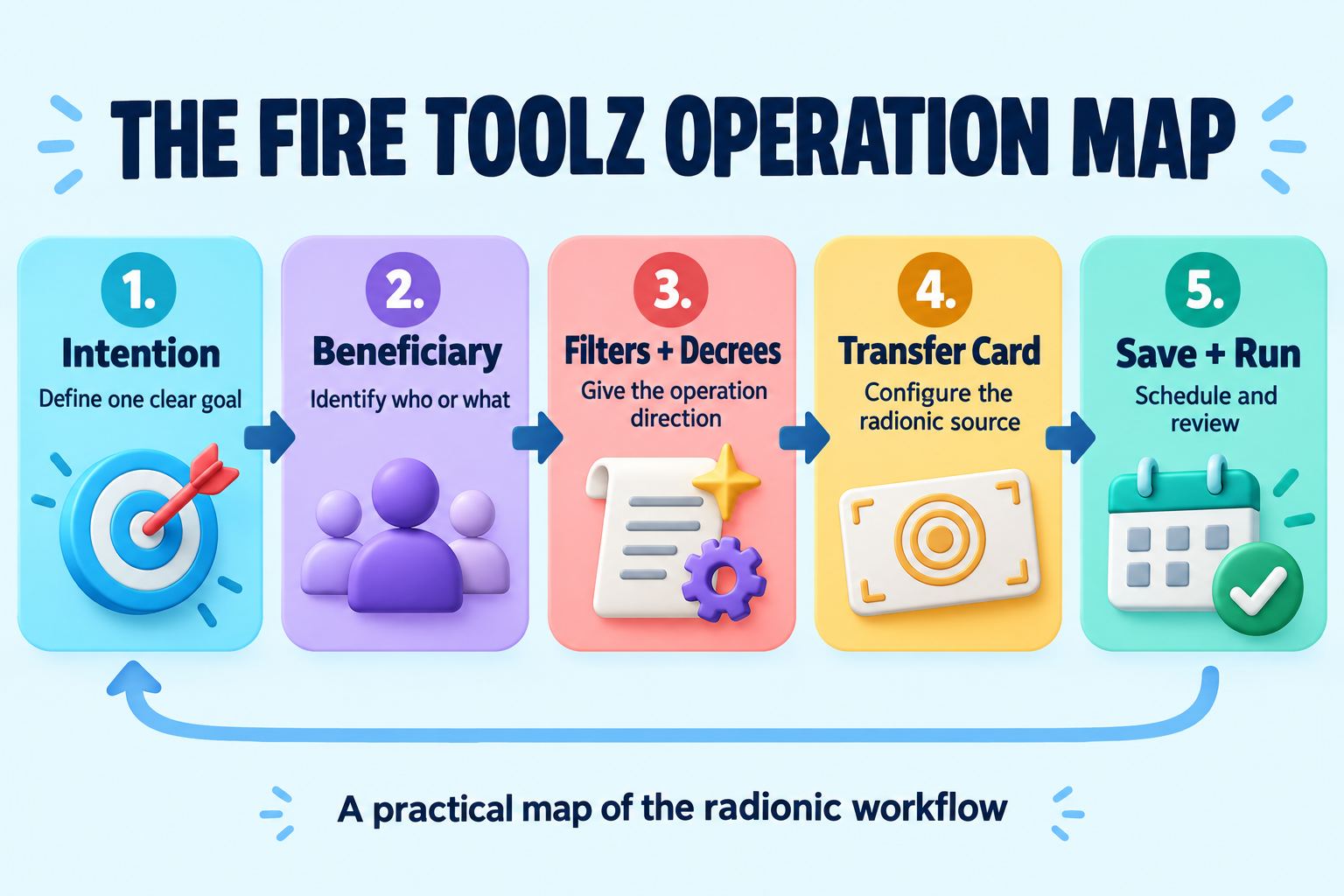
I teach Fire Toolz by starting with the structure of a complete radionic operation. Every element has a specific job. The beneficiary identifies the focus. The filters establish the tendency you want to cultivate. The decree gives that tendency a clear verbal direction. The transfer card supplies the configured radionic source. Fire Toolz brings these elements together in a visual workspace you can save, revisit, and run. Once you understand these relationships, the controls become part of a practical method rather than a collection of unfamiliar buttons.
I recommend learning that structure before building a complicated session. A coherent operation with a well-defined purpose is more useful than an elaborate arrangement you cannot explain. Clarity also makes the deeper ideas easier to approach: structural links, Chi, sacred geometry, the holographic worldview, and the relationship between radionics and quantum physics.
In this guide, I walk you through the software, its energetic vocabulary, and the quantum ideas that make the subject so fascinating. Use the visual maps to learn the relationships, the actual Fire Toolz screens to recognize the controls, and the practical example to build a coherent configuration. I also explain quantum entanglement in detail so that you can understand its physical meaning alongside the nonlocal philosophy of radionics. You will finish with a clear method for configuring your next operation.
Select any infographic or software screenshot to open the full-size image for a closer look.
1. What Fire Toolz does: organize a complete radionic operation
Quantum Radionics Fire Toolz is radionics and manifestation software built around an interactive visual workspace. It lets you arrange beneficiary images, radionic filters, decrees, transfer cards, audio, and other operation settings. Instead of rebuilding the same arrangement each time, you can save a configuration and load it again as a template.
The practical advantage is consistency. A saved operation preserves the relationships between its elements. You can refine your practice deliberately, compare configurations, and maintain a sequence without rebuilding everything from memory. I recommend treating each saved template as a complete working arrangement: give it a clear purpose, personalize its identifying fields, and add notes that make its choices understandable. Fire Toolz manages the arrangement and configured timing while you direct the intention and make the decisions that give the session its purpose.
Think of an operation as a sentence with several parts. The beneficiary answers “For whom or what?” The filter answers “In what direction?” The decree answers “With what precise intention?” The transfer card answers “Through which configured radionic source?” Timing answers “When and for how long will this arrangement run?” Remove the purpose from that sentence and the individual elements lose their relationship.
The beginner’s rule
Start with one clear objective, one clearly identified beneficiary, and a small coherent selection of filters. Add sophistication only when you can explain what the additional element contributes.
2. Three layers that make the whole subject clearer
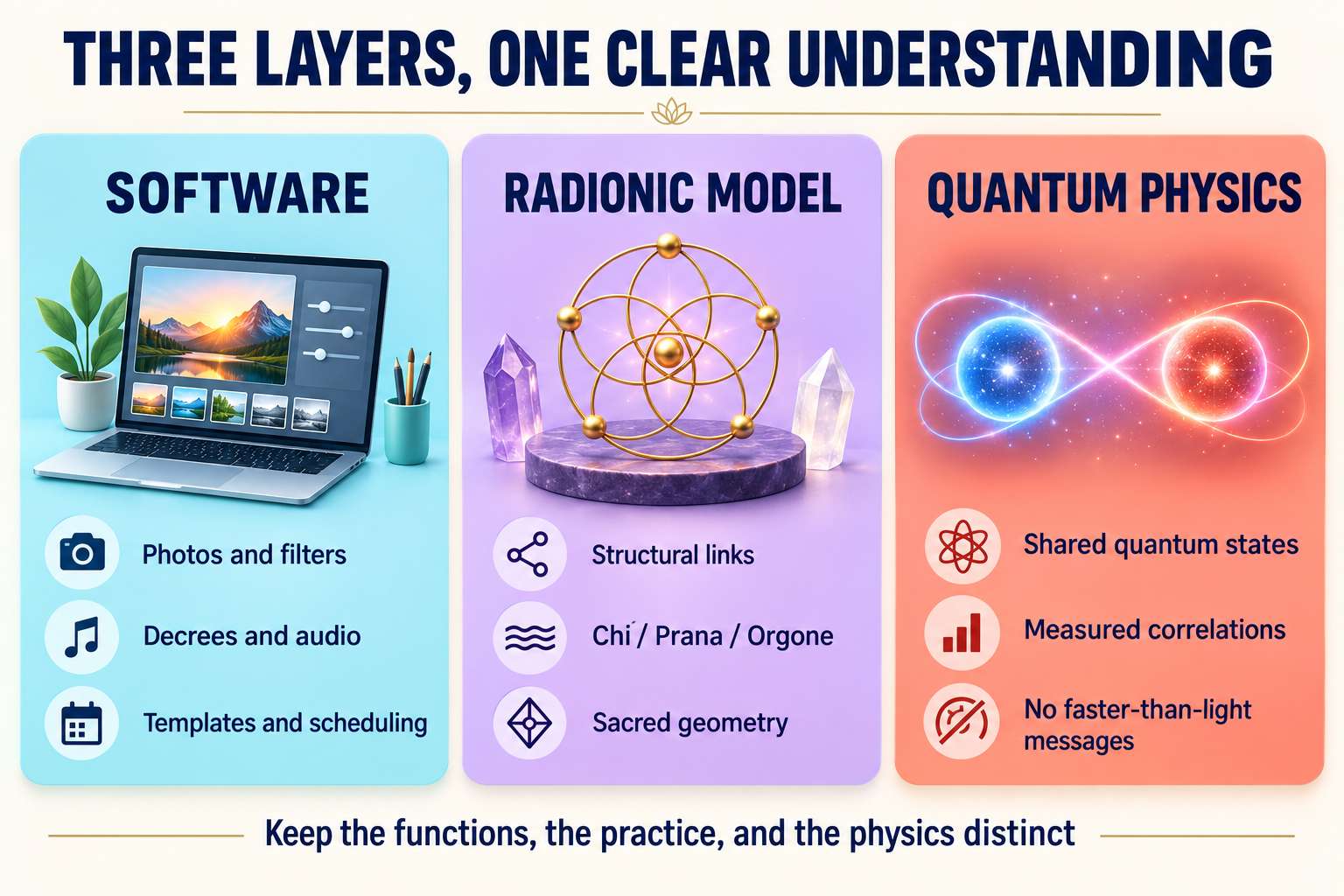
I organize this subject into three connected areas: the software, the radionic practice, and quantum physics. Start with the software. Load images, personalize decrees, save templates, include audio, and configure a schedule. These actions give you a repeatable workspace. Learn them directly at the screen, checking what each control contributes to your arrangement. This practical foundation makes the deeper concepts easier to understand because you can connect each idea to an actual configuration decision.
Next, understand the radionic practice. Relate the intention, structural link, energetic source, and selected tendency as parts of one operation. Chi, Prana, Orgone, sacred geometry, and the beneficiary link belong here. I teach these terms through their roles: the structural link identifies the focus, the filters establish direction, and the transfer configuration supplies the source component. This is a serious esoteric discipline with its own working vocabulary and a nonlocal metaphysical understanding of relationship.
The third is quantum physics: a mathematical and experimental account of physical systems, quantum states, measurement probabilities, interference, and entanglement. Its concepts are profound, but they have precise meanings. A shared quantum state is not the same thing as a saved Fire Toolz template. A measured quantum correlation is not the same thing as an operator’s interpretation of an energetic connection.
Use a precise vocabulary for each area. A software setting tells you what the program will execute. A radionic relationship tells you how you are organizing the practice. A quantum-physics statement tells you about a physical state or measurement. I recommend learning all three on their own terms and then exploring their philosophical connections. This approach lets you move confidently between practical configuration, energetic meaning, and scientific concepts while keeping the explanation clear.
3. Read the actual Fire Toolz workspace
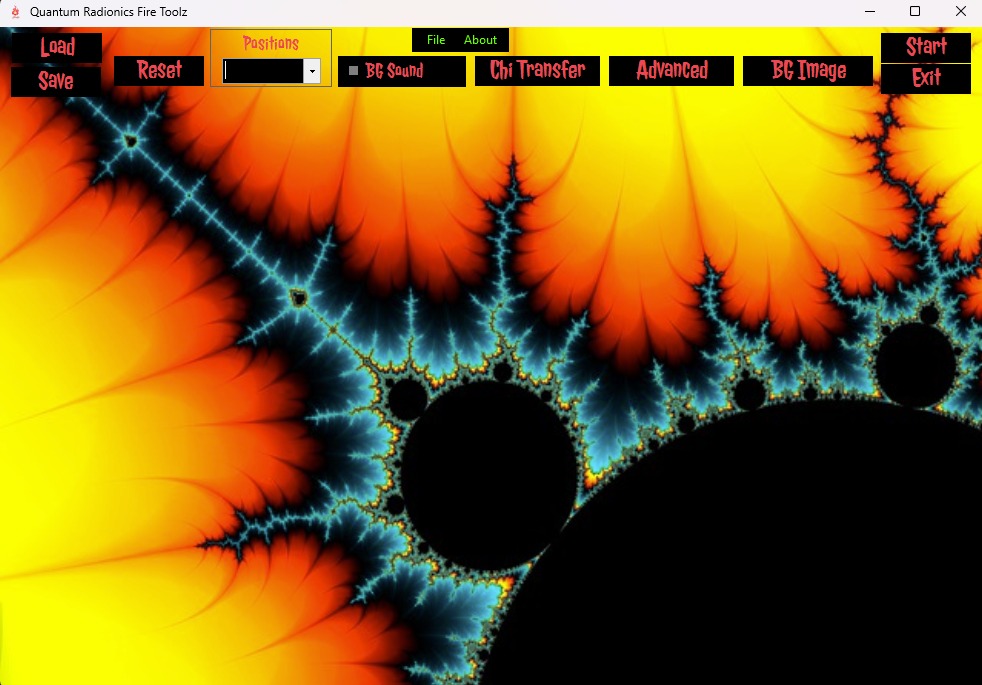
The main screen gives you the working controls for an operation. You will see labels such as Load, Save, Reset, Positions, Chi Transfer, Advanced, BG Sound, BG Image, and Start. Learn these controls as a workflow rather than as isolated features. Load restores a configuration; Save preserves it; Positions changes the arrangement; Chi Transfer relates to the transfer-card component; and Start initiates the configured operation.
The background controls help shape the visual and audio environment. A background image can support the atmosphere of your practice without replacing the beneficiary or the filters. Background sound is likewise a supporting element, not a substitute for a clear operation. Keep the distinction between an aesthetic setting and an operative component visible in your own planning.
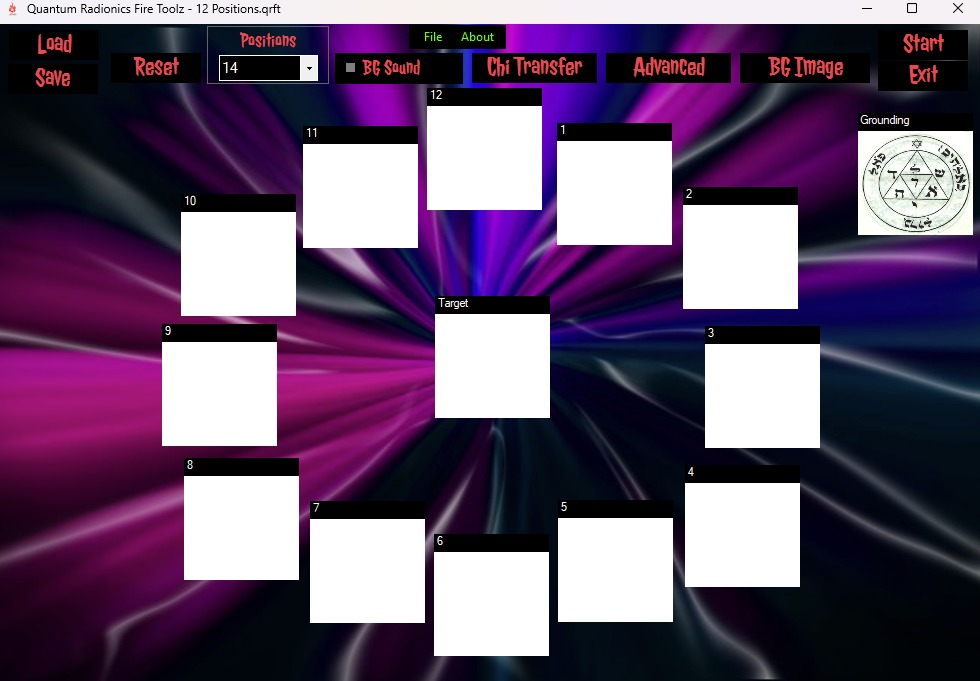
A layout can contain different kinds of positions. In the illustrated twelve-filter template, twelve numbered slots surround the central Target, while a separate Grounding position appears near the top right. The Positions selector shows fourteen because the total includes the target and grounding positions. This is a useful reminder: total positions and filter slots are not always the same count.
Read the labels on the configuration you are actually using. Do not assume that every screenshot, preset, or edition has the same arrangement. Layout is a practical question: how many operative elements do you need, and where will they sit so that the session remains understandable? More occupied positions do not automatically mean a better operation.
4. The beneficiary: identify the focus precisely
The beneficiary is the person, project, or other focus of the operation. A photograph and identifying name provide a practical way to establish that focus in the workspace. In radionics, this identifying element functions as a structural link: a representation used to relate the operation to its intended beneficiary.
Choose an image that clearly serves that purpose. If you are working with your own creative project, the beneficiary might be you or the project itself, depending on how you define the operation. Do not drift between those two choices halfway through the setup. A session about your own disciplined preparation is different from a session directed toward a project’s identity.
In your setup, give the photograph a clear identifying role. Place it in the beneficiary position and pair it with the intended name. I recommend checking that pairing before every new configuration, especially when adapting an existing template. The photograph and name should point to the same focus as the decree. This simple review keeps your structural-link arrangement consistent and prevents an old beneficiary from remaining in a session prepared for a different purpose.
Use consent and discretion when other people are involved. Keep personal images and identifying details private, and focus your practice on constructive purposes. A well-organized radionic session should be clear about its beneficiary without becoming careless about that beneficiary’s dignity or information.
5. Filters and decrees: give the operation a coherent direction
A radionic filter represents the tendency you are bringing into the operation. Rather than selecting cards because their names sound impressive, ask what role each one plays. Does it support the main goal? Does it duplicate another filter? Does it introduce a different objective that makes the arrangement harder to interpret?
The decree is the verbal direction of the session. Write it so that you can understand it immediately when you reopen the template. Replace generic beneficiary placeholders with the intended name or identifying language. Leaving an unedited placeholder in a saved operation weakens the practical clarity of the configuration even before you discuss its energetic interpretation.
I recommend a decree that is positive, specific, and aligned with the beneficiary’s agency. For a creative-work example, write: “I bring steady attention, clear preparation, and consistent action to completing my project.” Adapt the wording to your own purpose and keep its direction easy to understand. Read the whole sentence before saving it. A clear decree helps you recognize the operation immediately when you return to the template and keeps your verbal intention aligned with the selected filters.
Avoid packing unrelated goals into one sentence. “Finish my project, change another person’s feelings, resolve every problem, and receive instant success” is not one clear tendency. Separate distinct purposes into separate configurations. This makes your practice easier to review and prevents a template from becoming a miscellaneous wish list.
6. The transfer card: understand the source component
The transfer card supplies the source component within the radionic arrangement. Fire Toolz works with Chi transfer-card configurations, relating that component to the filters, decree, and beneficiary. In the energetic vocabulary of the practice, Chi, Prana, and Orgone refer to life-force concepts; these terms do not name an interchangeable, standardized unit of measured physical energy.
This is why I teach the relationship first: source, tendency, beneficiary. The transfer card is not the beneficiary. The filter is not the source. The decree is not merely a caption for an attractive image. Each component has a different role, and the operation becomes coherent when those roles work together.
Sacred geometry gives the transfer-card practice an organizing language. Flower-of-life patterns and geometries associated with the Giza arrangement establish its visual and metaphysical structure. I recommend learning the role of the particular geometry you select and keeping that choice consistent within the session. Study the pattern, recognize where it belongs in the transfer arrangement, and relate it to the operation’s purpose. Deliberate selection makes the configuration easier to understand than simply choosing the most ornate image.
External radionic or orgone equipment can belong to a broader structural-link practice, but it is not the same thing as a required cable-connected peripheral. Understand the actual configuration you are using. Do not imagine a physical connection where the operation is instead based on the metaphysical relationship of its elements.
Picture the operation as a three-part stack: source, tendency, and beneficiary. Fire Toolz brings those relationships into a configurable digital arrangement. Use this picture when reviewing your workspace: locate the source component first, identify the filters that establish the tendency, and confirm the beneficiary at the focus. Then read the decree and check that it connects those choices into a single purpose. This is the practical map I recommend keeping in mind as your configurations become more sophisticated.
7. Quantum physics without the vocabulary fog
Quantum physics describes matter and radiation at a level where everyday intuition is often insufficient. A quantum state provides a mathematical description from which we calculate the probabilities of measurement outcomes. Depending on the system and experiment, these outcomes may involve energy, position, spin, polarization, or other physical properties.
One of the central ideas is quantization. Certain observable quantities have discrete possible outcomes under particular conditions. An atom, for example, has specific energy levels rather than an unrestricted menu of stable energies. Learn this idea through the image of defined levels: a physical system occupies allowed states, and a transition between them has a specific relationship to energy. The word “quantum” points to that physical structure, giving us a precise starting point for the rest of the discussion.
Another central idea is probability amplitude. Amplitudes are mathematical quantities used to calculate probabilities, and their relationships allow interference. This is not simply ordinary uncertainty about an object whose properties are all waiting fully formed to be discovered. The theory predicts experimental patterns that require a quantum description.
Quantum mechanics also explains the physics underlying semiconductors and many other technologies. Fire Toolz runs as conventional software: it manages images, text, audio, saved configurations, and timing through ordinary computing operations. A quantum computer uses a different kind of computational resource, such as controlled qubits. Keep that distinction clear as you study the subject. Here, the quantum discussion helps you understand physical concepts and their philosophical relevance to radionics; the software workflow remains the visual arrangement you configure at the screen.
Keep the relationship clear
Quantum physics describes physical states and measurements. Radionics organizes intention, structural links, sources, and tendencies. Explore their philosophical connections while preserving the meaning of each.
8. Superposition and interference: possibilities with structure
Superposition means that a quantum state can be expressed as a combination of states associated with possible measurement outcomes. For a simple two-outcome system, we can describe a state as a combination of two basis states. The amplitudes associated with those states determine the probabilities of the corresponding outcomes when that measurement is made.
The crucial point is that a superposition has structure. The relative phases of its amplitudes matter. When alternatives contribute to an experiment, amplitudes can reinforce or cancel one another, producing interference. I recommend remembering both amplitude and phase rather than imagining a loose collection of equally likely possibilities. Together, these mathematical relationships determine the pattern of probabilities for a specified experiment. This makes quantum behavior both surprising and exact: the possibilities follow a defined physical description.
A visual analogy is useful if you remember its limits. Picture overlapping ripples producing stronger movement in some places and weaker movement in others. Quantum amplitudes can likewise combine to change predicted outcome probabilities. But those amplitudes are not ordinary water waves, and the analogy does not establish a mechanism for sending an intention through space.
For your Fire Toolz practice, apply coherence as a configuration principle. Select compatible elements and give the session a clear direction. Check that the beneficiary, filters, source component, and decree all support the same purpose. I recommend simplifying any arrangement whose parts pull in different directions. This practical use of coherence concerns how you organize your operation; quantum interference concerns how physical amplitudes combine in a specified experiment. The shared lesson is to understand relationships rather than accumulate unrelated parts.
9. Measurement: what the observer actually means
Quantum measurement is an interaction that yields an outcome associated with a chosen observable. The measurement arrangement matters: measuring one property is not necessarily equivalent to measuring another. A detector, apparatus, and experimental procedure can all be part of the measurement process.
The word “observer” causes unnecessary confusion when it is automatically equated with a conscious person wishing for a result. Quantum experiments do not require a human mind to stare at a detector for recorded events to occur. The physical measurement interaction is the essential operational issue.
Questions about the interpretation of measurement are genuinely deep. Different interpretations approach the relationship between the state, outcomes, and physical reality differently. Explore those questions by keeping the experimental procedure visible: what system was prepared, what property was measured, and what outcome was recorded? I recommend this sequence because it grounds an abstract discussion in something specific. It also helps you distinguish a philosophical interpretation of reality from the concrete steps of an experiment.
In practice, intention still has a clear role. It guides your choices, the meaning of the operation, your attention, and the actions you take around it. Your purpose gives the arrangement its direction. Keep that role distinct from a claim that the session physically controls quantum measurement outcomes.
10. Quantum entanglement: understand the shared state
Quantum entanglement occurs when the joint state of systems cannot be understood as a separable description of independent parts. The whole state contains relationships that are not captured by assigning each part its own independently complete state. The mathematics describes the systems together.
Consider an idealized pair of two-outcome systems prepared in a particular entangled state. When both are measured in the appropriate same basis, their results can be correlated. Each local result is unpredictable, yet the relationship between the collected results has a defined structure. Different choices of measurement basis reveal different patterns.
This is more subtle than imagining two envelopes that already contain matching answers. Classical objects can also be correlated: a pair of gloves separated into two boxes will yield opposite handedness when opened. The distinctive quantum issue is whether correlations across multiple measurement choices can be explained by a local model in which the outcomes were fixed in advance.
Bell inequalities provide a way to test that question under specific assumptions. Experiments with entangled systems violate those inequalities, ruling out the relevant class of local hidden-variable explanations. The achievement recognized by the 2022 Nobel Prize in Physics includes experimental work on those quantum correlations. Focus on the sequence: prepare physical systems, choose measurement settings, collect outcomes, and compare the resulting correlations. That sequence gives entanglement its experimental meaning and makes the distinction from everyday classical correlation clear.
11. Why entanglement does not send a controllable message faster than light
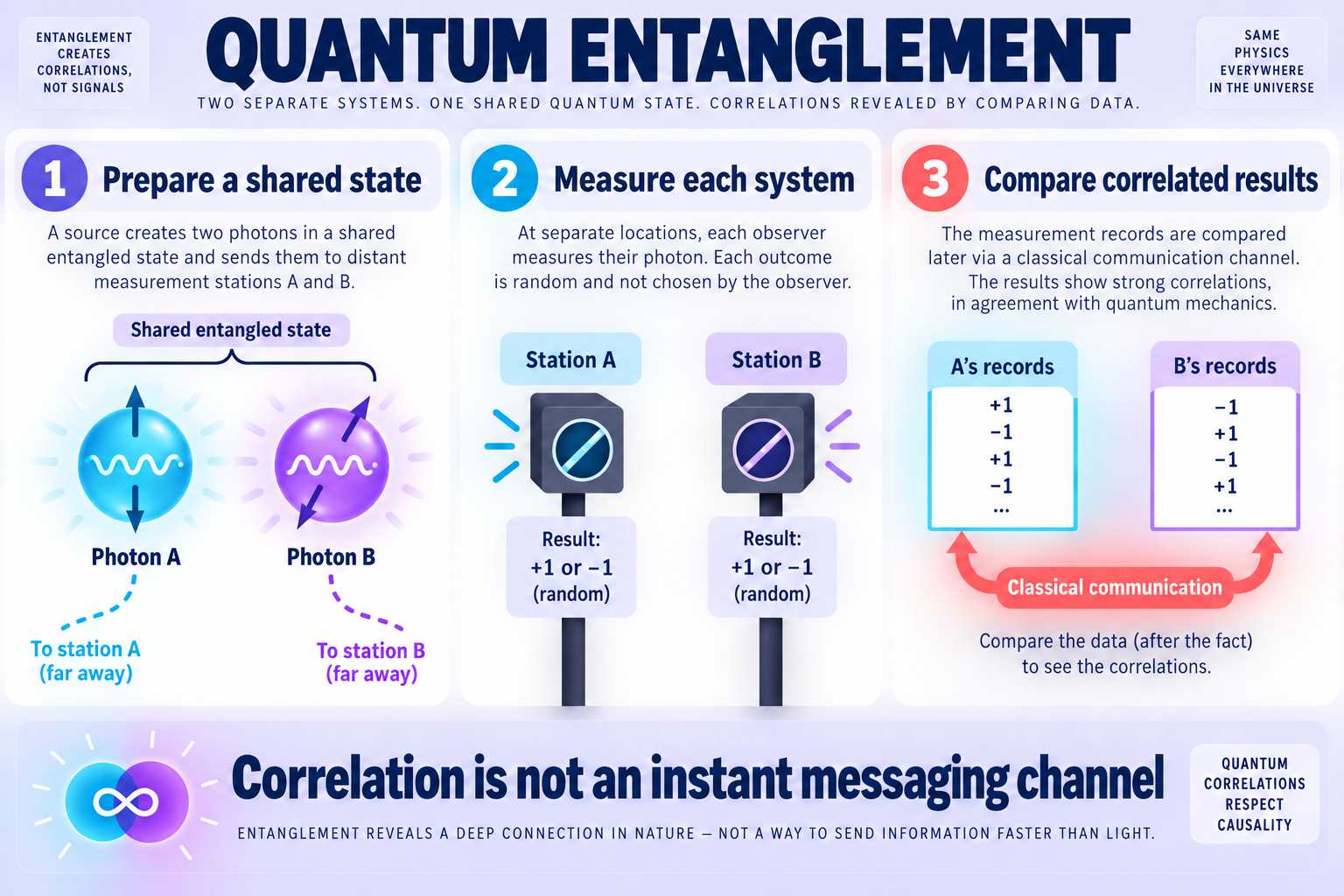
Entanglement produces correlations, but it does not let one observer choose a measurement result and make a distant observer receive that chosen result as a message. In the standard quantum account, the local data do not reveal a controllable signal sent through the entangled relationship.
To see the correlations, observers compare their records. That comparison uses an ordinary communication channel. A striking relationship between two datasets therefore does not remove the need to exchange information in the usual way. “Correlated” and “communicating” are not synonyms.
Quantum teleportation is another term that deserves precision. It transfers the quantum state of a system through a protocol that requires a shared entangled resource and classical communication. It does not teleport a person, a photograph, or a chosen thought instantly across the universe. The classical communication requirement prevents the protocol from serving as a faster-than-light messaging system. The quantum teleportation protocol makes that requirement explicit.
Distance is not the only practical issue. Establishing, preserving, and measuring entanglement demands controlled physical conditions. Interactions with the environment can degrade the relevant quantum coherence. Loading two related pictures into a desktop program does not perform the physical preparation and measurement steps of such an experiment.
12. Where quantum ideas meet the radionic worldview
The radionic worldview treats relationship, intention, and structural correspondence as fundamental to an operation. It approaches the beneficiary link and the configured tendency through a nonlocal metaphysical model rather than through a conventional mechanical chain of contact. This is the conceptual setting in which Fire Toolz brings images, decrees, transfer cards, and sacred geometry together.
I introduce quantum entanglement here because it brings the importance of relationship into sharp focus. The physical description belongs to the joint state, and the resulting correlations challenge simple everyday intuition. For an exploration of a relational universe, that is a profound idea. Carry it into your philosophical study with precision: an analogy can open a useful question, while an experimentally demonstrated mechanism requires its own preparation, measurement, and testing.
The distinction is straightforward: a radionic structural link is a deliberate connection within the practice; a quantum-entangled pair is a specifically prepared physical system described by a joint state. The first gives the operation its intended focus. The second yields experimentally testable measurement correlations. Calling both “connection” does not make their conditions interchangeable.
I recommend returning to the operation map whenever the terminology becomes abstract. The beneficiary defines the focus. The filter defines the tendency. The decree establishes the verbal direction. The transfer card supplies the configured radionic source. These are the relationships you arrange in Fire Toolz. Physical entanglement is a prepared shared quantum state; loading a beneficiary photograph does not establish that state or a faster-than-light channel. With this distinction clear, you can study the nonlocal philosophy of radionics and the science of entanglement without confusing their procedures.
13. The holographic perspective: parts, wholes, and information
A holographic perspective encourages us to think about relationships between parts and wholes. In an optical hologram, information about the recorded scene is distributed in a way that differs from an ordinary photograph. That physical example has inspired broader reflections about information, perception, and reality.
The holographic universe tradition, associated with writers such as Michael Talbot and discussions of David Bohm’s ideas, extends those reflections into a philosophical worldview. It asks whether the apparent separateness of things conceals a deeper order of relationship. That question fits naturally beside a radionic practice built around structural correspondence.
I separate three uses of the word “holographic”: optical holography, philosophical accounts of an implicate order, and holographic ideas in theoretical physics. Each has a different subject and purpose. Optical holography involves recording and reconstructing light-wave information. An implicate-order discussion asks about a deeper relationship between parts and wholes. Theoretical physics uses mathematical proposals with their own conditions. Keeping those meanings distinct makes your study more rewarding and your explanation more precise.
Use the holographic perspective as a way to contemplate relationship and organize meaning. In Fire Toolz, the practical task remains specific: identify the beneficiary, choose the tendency, configure the source, write the decree, and save a coherent operation. A large worldview becomes useful when it clarifies those concrete decisions rather than replacing them with vague language.
14. Build a complete operation: a creative-project example
To show you the complete method, I will use a hypothetical creative project. The purpose is disciplined preparation and completion. Follow the steps as a configuration example and adapt them to a project of your own. Start with a manageable task so that you can understand the whole arrangement, save it clearly, and connect the operation with a practical next action. This is the learning sequence I recommend before developing a more elaborate protocol.
Step one: define the purpose outside the software
Write one sentence that identifies the goal. For example: “I want to bring clear attention and consistent preparation to finishing my project.” Decide what completion means in practical terms: a finished outline, an edited file, or a prepared presentation. A concrete task keeps the operation connected to something you can review honestly.
Step two: identify the beneficiary
Choose whether the focus is you as the creator or the project as a distinct undertaking. Load the appropriate identifying image and use a consistent name. Avoid a cluttered image containing several unrelated people or projects when your intention concerns only one. Make the identity easy to recognize when you reopen the configuration later.
Step three: select a coherent filter arrangement
Select available filters whose actual themes match your purpose. Review the card names in your collection and choose each one for a specific role in the arrangement. I recommend writing a short note about that role: what tendency does this filter add, and how does it support the project? If several selections compete with one another, simplify. A coherent selection makes the operation easy to understand when you return to it later.
Step four: personalize the decree
Replace any generic beneficiary wording. Keep the direction aligned with your goal and with actions under your control. Read the complete decree aloud before saving it. If you cannot explain the sentence without adding several qualifications, rewrite it. Clarity in language is part of clarity in configuration.
Step five: configure the transfer component
Choose the Chi transfer arrangement appropriate to the practice you are using. Check that you have not mistaken a decorative background for the operative source component. Review the relationship among source, tendency, and beneficiary. At this stage, the map should be understandable even to you a week later.
Step six: save, run, and take practical action
Save the template with a meaningful name, such as “Creative Project — Preparation.” Add notes explaining your purpose and configuration choices. Run the operation through Start or the appropriate configured schedule. Then do the real work: outline, create, revise, and complete the task. Radionic practice and responsible action belong together.
Before you press Start
Check the beneficiary, personalized decree, filter roles, transfer component, and saved configuration. Then check the practical next action you will take alongside the session.
15. Audio, touchplate, and grounding: supporting the practice
Include audio alongside images and other settings when it serves your operation. Affirmations, frequencies, or binaural material can form part of a selected arrangement. I recommend matching the audio to the purpose, checking the file you have selected, and setting playback at a comfortable level. Consider its wording, atmosphere, and role in your own attention. Record that choice in the template notes so that the audio remains an intentional part of the configuration.
The virtual touchplate gives you an interactive component in the workspace. Use it as part of your engagement with the operation, bringing attention to the beneficiary and selected tendency. I recommend learning its interaction separately before adding several other elements at once. This makes the control familiar and lets you recognize what you are doing during the session. Keep its role clear in your notes alongside the decree, filters, and transfer configuration.
A grounding position also has a distinct role in the illustrated layout. Do not count it as another ordinary filter simply because it occupies a box. When working with a preset, preserve the intended role of each position until you understand the arrangement well enough to modify it deliberately.
Notes are especially useful when supporting elements multiply. Record which audio you selected, why it belongs, and whether you changed the background or grounding arrangement. A session with several components should become more intelligible through your notes, not more mysterious.
16. Templates and scheduling: consistency without constant rebuilding
Templates preserve the configured operation so that you can return to it. Save images, decrees, audio, transfer choices, radionic values where used, and notes together in a coherent configuration. Use names that tell you the purpose of the operation rather than names that only tell you the day you created it.
The advanced timing functions let you plan operations instead of manually initiating every transition. Automatic Clock settings can define a future start and stop. Repeating time-based arrangements support recurring practice. Check whether you are setting a dated event or a recurring time, because those are different scheduling intentions.
Keep the computer on and Fire Toolz running for a scheduled operation. Disable sleep for the planned period and check that your laptop will remain active if you step away. I recommend reviewing these conditions before relying on an unattended session: power, program status, start time, stop time, and the intended template. The schedule depends on the active computer, so make this operational check part of your preparation rather than discovering an interruption afterward.
The Artillery function organizes a sequence of templates with specified durations and an optional repeat arrangement. Think of it as an ordered protocol. The sequence preserves the order you choose; it does not decide that order for you. Use it when different configurations genuinely serve different stages, not merely to make a simple purpose appear more advanced.
Do not borrow a duration from an unrelated example and turn it into a universal rule. Set timing deliberately within the practice you are following. Review saved schedules before relying on them, especially after changing templates or moving files. Automation should make your operation more consistent, not less understood.
17. Keep a useful practitioner journal
A journal turns repetition into something you can examine. Record the date, purpose, beneficiary, filters, decree, transfer configuration, timing, and the practical actions taken around the session. When you modify an operation, identify what changed. Otherwise, you may attribute a difference to the wrong element.
Record your observations specifically. If your creative task moved forward, note the actual progress: an outline completed, a revision finished, or a presentation prepared. Include the practical work, external circumstances, and feedback that accompanied the session. I recommend separating the configuration record from the observation record so that both remain clear. This gives you a useful account of what you arranged and what happened around the practice, rather than relying on a vague memory of the day.
A personal observation and a controlled scientific demonstration are different kinds of evidence. Both can be discussed honestly, but they answer different questions. Your journal helps you develop a thoughtful practice; it does not, by itself, establish that entanglement transmitted an intention.
When a session needs troubleshooting, check the configuration first. Was the beneficiary correct? Did a decree retain a placeholder? Was the intended template loaded? Did the computer sleep? Did the schedule use the wrong date? I recommend keeping this checklist beside your session notes. Resolve the practical issue, record the correction, and save the revised arrangement under a clear name. A dependable routine makes advanced practice easier because the basics remain consistent.
18. Common questions about Fire Toolz and quantum radionics
Is Fire Toolz a quantum computer?
No. Treat it as radionics software with a quantum and holographic conceptual framework, not as a processor that prepares and measures qubits. Conventional computer hardware has quantum physics beneath its material operation, but that does not make every application a quantum-information experiment.
Does loading a photograph create quantum entanglement?
No. The photograph serves as a beneficiary identifier and a structural link in the radionic practice. Physical entanglement requires appropriate preparation of quantum systems. Loading an image file does not perform that preparation.
Do I need to fill every position?
No. Build an arrangement that serves the purpose. Empty positions are preferable to unrelated additions that blur the operation. Learn the roles of Target, Grounding, and numbered filter slots in the layout you are using.
Can the software replace clear intention and practical action?
No. The program organizes configurations and timing. You choose the beneficiary, purpose, decree, and arrangement. Take constructive action alongside the operation rather than treating software execution as a substitute for preparation, communication, or work.
Can I promise a result within a fixed deadline?
No. A scheduled duration tells you how long the software operation is configured to run. It is not a guarantee that an external event will occur within that period. Keep timing, observation, and outcome claims distinct.
What should a beginner learn first?
Learn the source–tendency–beneficiary relationship, the main controls, personalized decrees, and saving templates. Then study scheduling and sequences. Quantum vocabulary becomes useful when it clarifies relationships, not when it replaces understanding of the basic workspace.
Bring clarity to your next Fire Toolz operation
The most important skill is not adding more elements. It is knowing what every element contributes. Identify the beneficiary precisely. Give the filters a coherent purpose. Personalize the decree. Configure the transfer component deliberately. Save a template you can understand later, and keep the computer active when scheduling depends on it.
I recommend bringing the same clarity to your study of the quantum and holographic worldview. Learn what a shared state means, how measurement correlations are compared, and how structural links function in a radionic arrangement. Then return to the workspace and apply what you understand: a precise beneficiary, coherent filters, a personalized decree, a configured source, and a saved operation. This combination of thoughtful study and deliberate preparation gives you a clear path for developing your Fire Toolz practice.
Explore Quantum Radionics Fire Toolz
Start with a clear intention and build an operation whose relationships you understand. Explore the software and its available options, then return to this visual guide as you develop your practice.