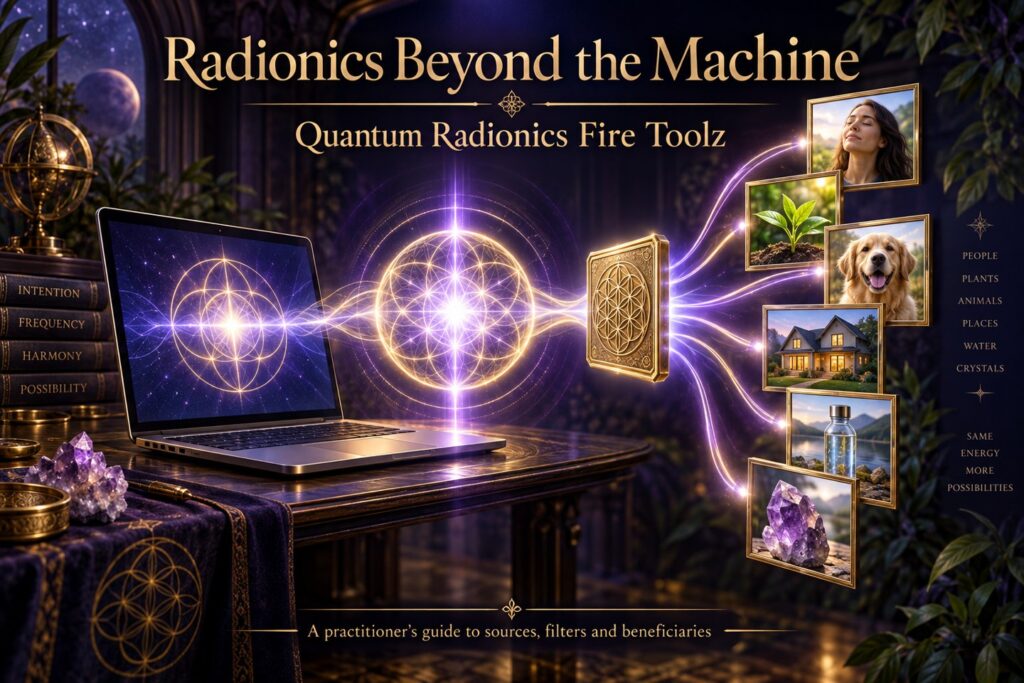
A photograph of a person. A bottle of water on a kitchen counter. A favorite crystal, a garden, an animal, or a room where you want to cultivate a different atmosphere. These may seem like unrelated subjects, yet they share something essential in radionics: each can become the clearly identified beneficiary of an operation.
Radionics begins with a practical question: what do you want to direct, and where do you want to direct it? Quantum Radionics Fire Toolz gives that question an organized working structure. Instead of configuring a dedicated machine for every session, you arrange a target photograph, a Chi transfer card, radionic filters, and written intentions in software. Save the arrangement, personalize it, and run it manually or through the scheduling functions.
The possibilities extend well beyond sending an intention to a person. They include raw Chi transfer, specific vibrational tendencies, frequency imprinting into materials, energetic cleansing, crystal programming, personal development, manifestation, and work with places, plants, animals, and objects. Understanding the roles of the components makes those possibilities easier to use intelligently. Let us build that understanding from the foundation upward.
Select any infographic to view its full-size labels and details.
1. What radionics works with: source, tendency, and beneficiary
Radionics is a practice of directing subtle energetic intentions through a deliberately configured relationship between a source, a tendency, and a beneficiary. The source provides the energetic foundation. The tendency specifies the quality or purpose of the work. The beneficiary identifies the destination. These three roles are the backbone of an operation, whether your working tools are physical instruments, printed cards, or software.
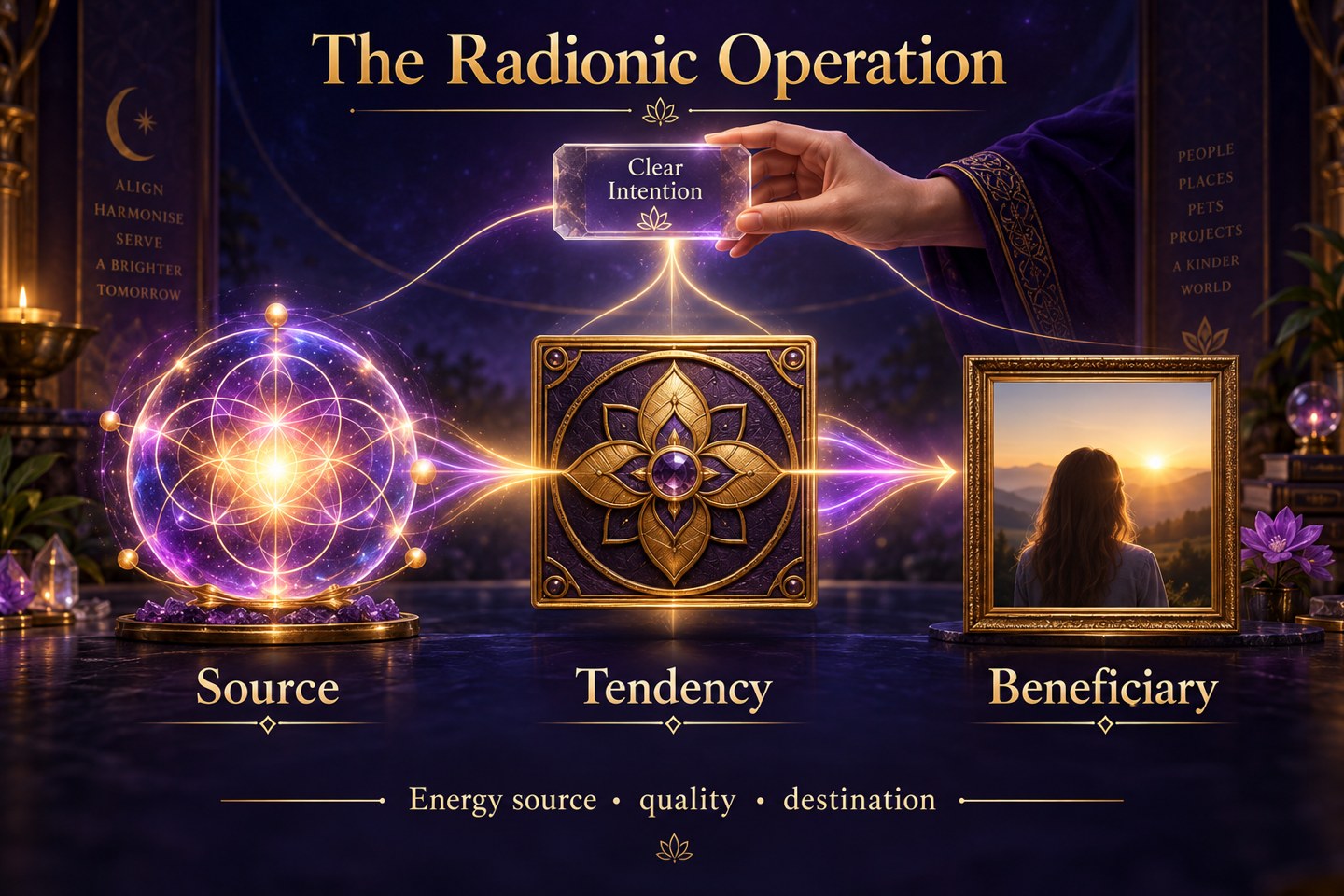
In Fire Toolz, the Chi/Orgone transfer card supplies the source function. A radionic filter, image, written decree, or related combination introduces the tendency. The photograph in the beneficiary position identifies the person, place, living being, or material toward which you direct the operation. A template brings these elements together in an arrangement you can review, save, and reuse.
Think of a session for inner peace. The photograph identifies the beneficiary. The filter expresses inner peace. The transfer card supplies the energetic foundation within the radionic practice. Adding a name to the decree makes the intention more specific, but the name does not turn an unrelated photograph into the correct target. Each element must agree with the others.
Chi, Prana, and Orgone are names associated with life-force traditions. They have different historical contexts, yet they serve a related functional role in this practice: the vital energetic foundation that supports an operation. A filter then gives the work a particular direction, such as harmony, vitality, concentration, or a chosen remedy tendency. The beneficiary provides the focus for that direction.
The quantum and holographic framework gives this craft an informational view of reality. In the holographic perspective, the visible object is part of a larger interconnected order; the photograph becomes a structural link within radionic work. Intention, pattern, and representation therefore matter alongside the physical appearance of the tools. The operator works with relationships and qualities, rather than treating the interface as a collection of unrelated pictures.
Keep the scientific distinction clear: a structural link identifies a beneficiary in radionics; physical quantum entanglement is a shared quantum state prepared under specific conditions. A photograph does not establish that physical state. The quantum vocabulary in Quantum Radionics Fire Toolz names its metaphysical framework, rather than proving a laboratory mechanism for energy transfer through photographs.
I recommend learning the three roles before learning elaborate combinations. Ask yourself: what is my source, what tendency am I introducing, and what exactly is the beneficiary? If you can answer those questions without hesitation, your configuration has a coherent foundation. If you cannot, adding more cards will make the arrangement harder to understand. Clarity is an operator’s first working tool.
2. How Fire Toolz differs from a traditional radionics machine
A traditional radionics machine gives you a physical working instrument. Depending on its design, it may include rate dials, a witness well or plate, a rubbing surface, connections for additional equipment, or positions for remedies and samples. The operator configures that particular instrument and keeps track of the settings associated with each session. Instruments vary, so there is no single hardware arrangement shared by every machine.
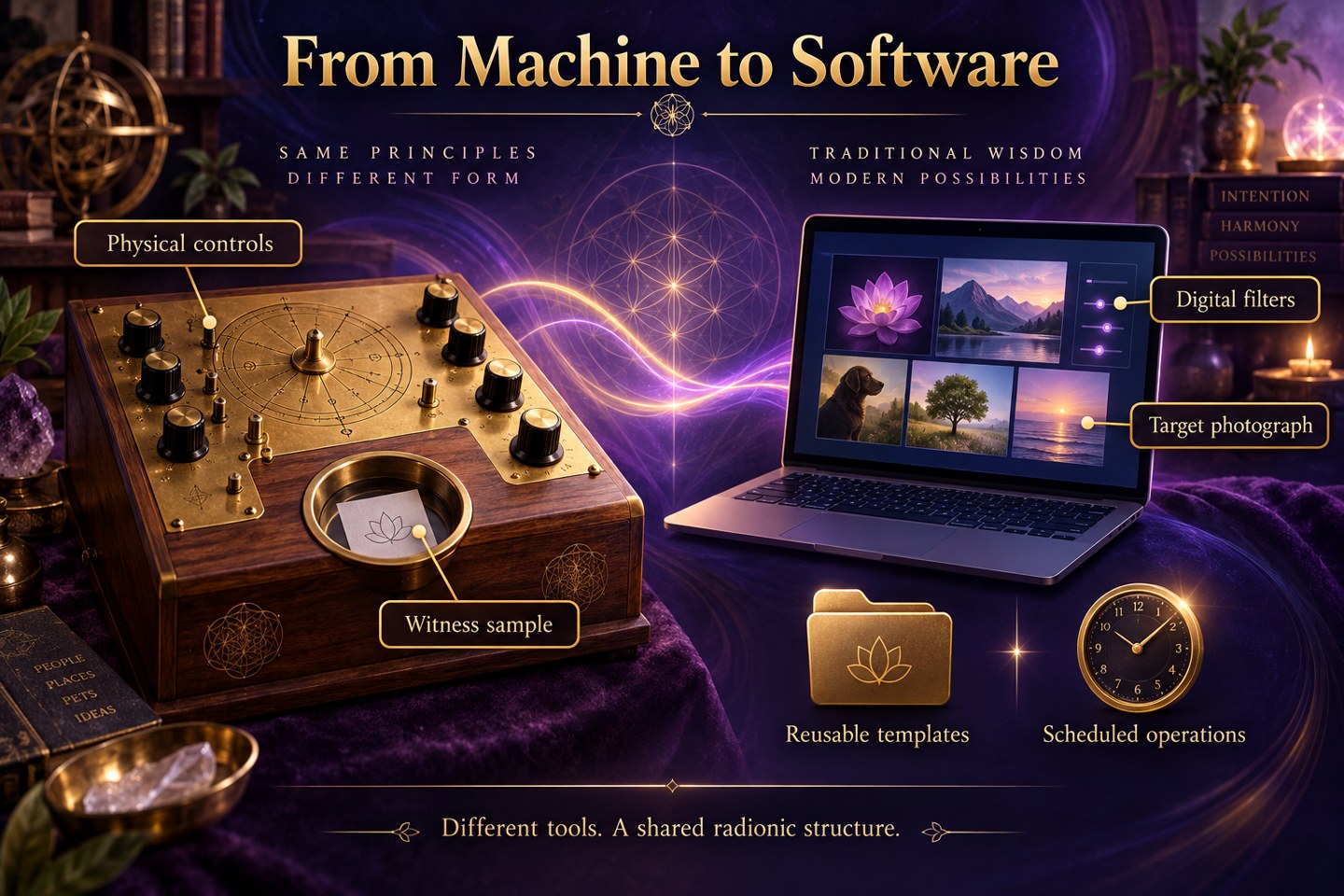
Fire Toolz moves the arrangement into a digital workspace. Instead of relying on a sample well to hold the witness, you load a photograph into the beneficiary position. Instead of limiting your configuration to the physical controls provided by one instrument, you work with image positions, filters, decrees, radionic values, audio options, and transfer-card management. The essential radionic relationship remains recognizable, while the working tools change.
The included Chi transfer card is central to this difference. Fire Toolz can be configured without a separate radionics machine or Orgone generator. An operator who already uses physical equipment can also work with an appropriate transfer-card configuration associated with that equipment. Hardware integration is an option within the practice, rather than a prerequisite for using the included source card.
Saving a template is another substantial difference. A template preserves an arrangement for later use: its images, decrees, radionic values, sounds, transfer-card configuration, and notes. You can maintain a simple water-charging template, a concentration template, a crystal-programming template, and a sequence of cleansing operations without reconstructing each arrangement from memory every time.
Software also makes timing more flexible. An automatic clock can start and stop a personalized operation. Daily scheduling can organize recurring work. Artillery mode can run a series of templates in order, with an individual duration for each. Some physical instruments offer automation too; the useful comparison is the specific workflow available to you, rather than assuming every traditional machine is operated entirely by hand.
Fire Toolz includes a virtual touchplate for intention and radionic-value work. It also supports audio for individual positions and background audio for a whole template. These features let you combine visual patterns, written language, numbers, and sound in one saved configuration. The virtual touchplate’s values belong to the operating method; they are not clinical readings or calibrated measurements of physical energy.
The practical benefits are portability of configurations, repeatability of setup, editable content, and organized scheduling. A saved file is much easier to review than an undocumented arrangement of knobs and loose cards. That does not establish that software is scientifically more powerful than every machine. It gives you a different, versatile way to conduct the craft. Choose your tools by the operations you want to build and the discipline with which you will use them.
3. The photograph determines where you direct the operation
The beneficiary photograph is the targeting element. It answers the question, “Where is this operation directed?” A person’s photograph identifies that person. A photograph of a dog identifies the dog. A photograph of your garden, a room, a bottle of water, or a particular crystal identifies that subject. The target therefore extends beyond human beings: it can be a place, a plant, an animal, a material, or an object.
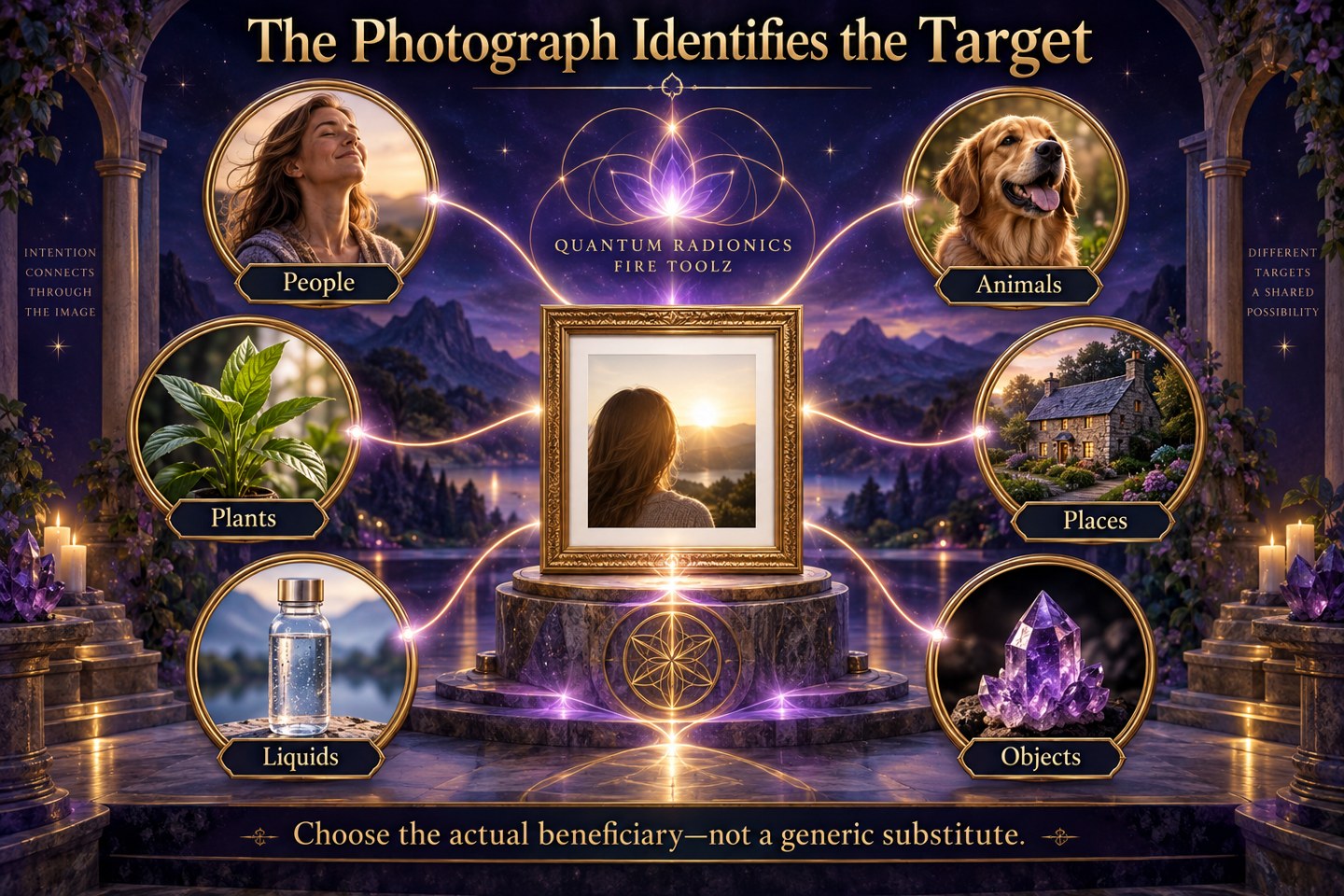
In radionics, this representation is called a witness or structural link. You use it to connect the configuration with the subject of your work. A generic picture of a glass may illustrate water as an idea, but a photograph of the actual glass you intend to work with provides a specific beneficiary. The same distinction applies to a stock photograph of a house and a photograph of your own home.
A clear picture helps you avoid ambiguity. If you want to work with one plant, photograph that plant closely enough to distinguish it. If you want to address a particular room, use a photograph that makes the room recognizable. If you want to imprint the contents of a particular bottle, photograph that bottle and identify its contents in the accompanying text. The image and decree should describe the same subject.
The photograph identifies the destination in both basic and elaborate operations. Raw Chi transfer still needs a beneficiary. A filtered operation still needs a beneficiary. Adding a Reiki card, a color pattern, or an astrological filter does not automatically tell the operation which person, animal, or place you mean. Those resources specify qualities; the beneficiary position supplies the target.
You can support the image with a full name or a precise label. For a person, personalize every decree that contains a beneficiary placeholder. For a place, use a clear location description appropriate to your own records. For an object, distinguish it from similar objects. You do not need to collect unnecessary private information to make a coherent configuration.
Group photographs require particular attention. A picture containing several people can make your intended focus unclear. Crop the image to the consenting beneficiary, or build a deliberately defined group operation when the purpose and participants belong together. Separate operations are often easier to review when each beneficiary has different needs or different filters. The same principle helps when working with several plants or several bottles.
Distance is not a positioning parameter in this method. The beneficiary does not need to sit beside the computer, and a remote place does not need to be physically accessible during the operation. You identify it through its structural link. That describes the radionic working method, rather than a measured transmission speed or a proven physical communication channel. For people, use their photographs with permission and frame the work around their freely chosen wellbeing and aims.
4. Raw Chi transfer and filtered transfer: two distinct configurations
Raw Chi transfer is the simplest energetic arrangement: the Chi transfer card provides the source, and the beneficiary photograph identifies the destination. You are directing the source’s life-force quality without adding a separate radionic filter to specify a further tendency. Here, “raw” means unfiltered within the configuration. It does not mean a laboratory measurement of purity, voltage, or biological energy.
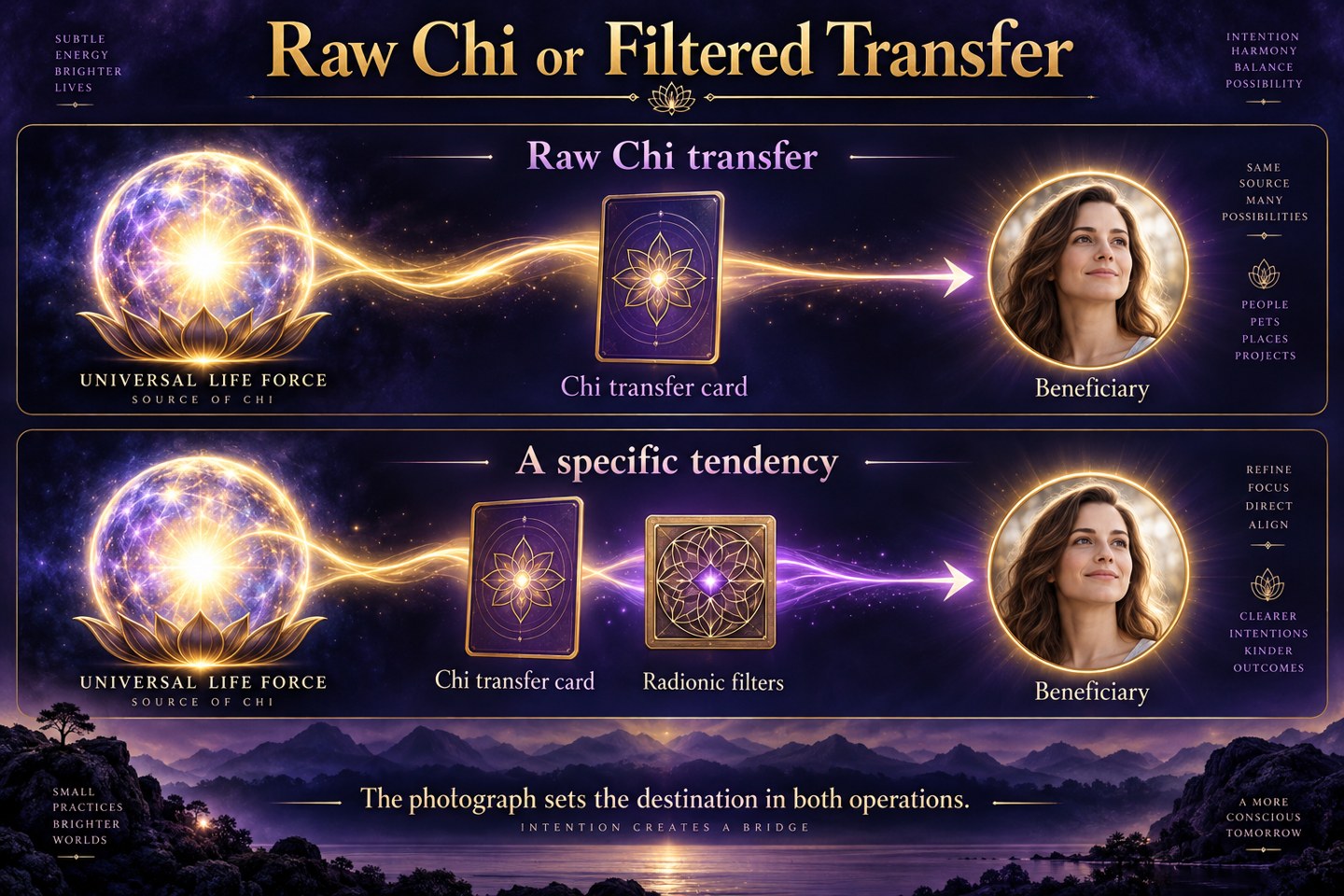
A useful example is a basic session directed toward a photographed bottle of water. You configure the source and identify that particular bottle as the beneficiary. The intention is straightforward Chi charging. Another example is a general life-force session for yourself, using your own photograph. You can keep a written description for clarity without confusing that simple purpose with a complex remedy combination.
Filtered transfer adds another role between the source and destination. A filter introduces a specific tendency: inner peace, harmony, concentration, a particular traditional remedy pattern, or another quality appropriate to the operation. The working relationship becomes source, filter or filters, and beneficiary. The photograph continues to identify the destination; the filters specify what you intend to direct there.
Consider a plant as the beneficiary. A raw configuration addresses the plant with the source’s general Chi quality. A filtered configuration may introduce vitality and harmony as distinct tendencies. For a room, raw transfer and a filtered atmosphere operation are different setups. For water, raw charging and imprinting a chosen remedy tendency are different purposes. Keeping these distinctions clear prevents vague instructions such as “send everything good.”
Filters can be traditional radionic cards, power symbols, sacred geometry, astrological patterns, images representing a desired state, or written decrees. Fire Toolz lets you combine image and language so that an operation carries a specific meaning. Radionic values and audio can add further elements when they genuinely belong to that purpose. A beautifully illustrated card still needs an understood role.
Choose combinations that cooperate. Concentration, comprehension, and calm attention can support one study session. An unrelated business-sale objective belongs in another operation. A single focused filter can be more intelligible than a screen full of loosely connected ideas. Repeating a filter gives emphasis within the radionic arrangement, but it does not provide a calibrated multiplier of physical power.
The distinction also helps with troubleshooting. If a session feels unclear, ask whether you intended raw Chi or a specified tendency. Then check the source card, beneficiary image, enabled state, and text. Do not keep adding filters to compensate for an incorrect photograph or an inactive transfer card. A precise configuration lets you understand what you actually ran, compare future sessions fairly, and preserve a template whose purpose remains obvious when you reopen it.
5. Frequency imprinting into water, liquids, food, vitamins, and objects
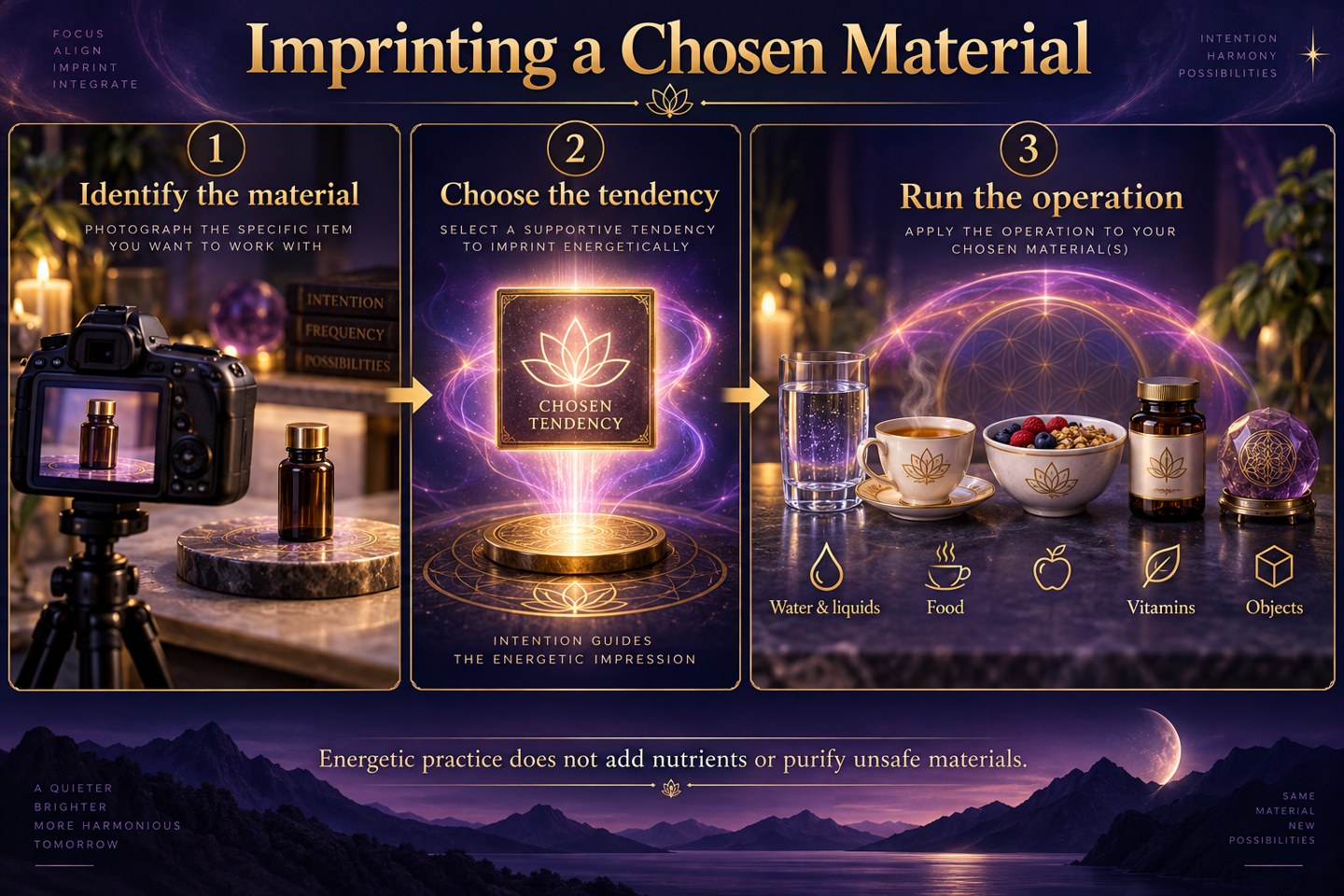
Frequency imprinting is the radionic practice of directing a chosen vibrational tendency toward a material beneficiary. Water is a familiar starting point, but the same configuration logic can address another liquid, food, vitamins, sugar globules, pellets, or a non-edible object. Identify the actual material, select the intended tendency, configure the Chi transfer card, and run the operation with a clear purpose.
“Frequency” needs a precise meaning here. A radionic remedy tendency or a card’s energetic correspondence is part of the practice’s vibrational language. An audio tone measured in hertz is a physical sound frequency. These terms can appear together in a template, but they are not interchangeable. Loading a named audio file does not establish that a substance has acquired a measurable medicinal property at that frequency.
For water, take a photograph of the specific glass, bottle, or container. Load that image as the beneficiary, and describe whether you are conducting raw Chi charging or directing a chosen filtered tendency. If you use a traditional remedy card, keep its identity clear. A general harmony filter and a specific remedy card serve different purposes, even though both can appear in material-imprinting work.
Other liquids can be identified in the same way: a particular cup of tea, a bottle of a safe drink, or another suitable material already in your care. Photograph the actual container and state what is inside it. “Any liquid” describes the breadth of possible targeting, not permission to consume an unsafe liquid or to treat all substances as chemically equivalent.
Food can also be the beneficiary. A photograph of a prepared meal, a fruit, or a specific batch identifies what you intend to work with. Vitamins and supplements can be represented by a photograph of the actual bottle or selected items. In this application, you direct an energetic intention toward the material; you are not manufacturing vitamins, increasing their dose, changing their ingredients, or replacing nutrition through a picture.
Traditional card systems include Malcolm Rae, Sai Sanjeevini, and Bach Flower tendencies. These can be configured for radionic remedy creation, copying, and transfer. Water, globules, and pellets are familiar carriers in these traditions. Copying a remedy tendency is an energetic practice; it does not demonstrate duplication of a chemical ingredient or its pharmacological action. Do not relabel a preparation as a clinically proven medicine because you ran a template.
I recommend a simple material-imprinting workflow. First, choose one identifiable material. Second, photograph and label it. Third, decide whether the operation is raw or filtered. Fourth, configure only the resources that belong to that purpose. Fifth, review the beneficiary and decree, save the template, and run it for the period appropriate to your chosen method. Finally, record what you configured and what you observed.
Maintain ordinary hygiene, storage, and handling throughout. Radionic imprinting does not make contaminated water potable, remove toxins from food, or turn an inedible liquid into a drink. Follow supplement labels and professional guidance. Those material facts remain part of competent practice, just as caring for a crystal means respecting its physical fragility. Energetic work and physical care belong together.
6. Directing operations toward people, plants, and animals
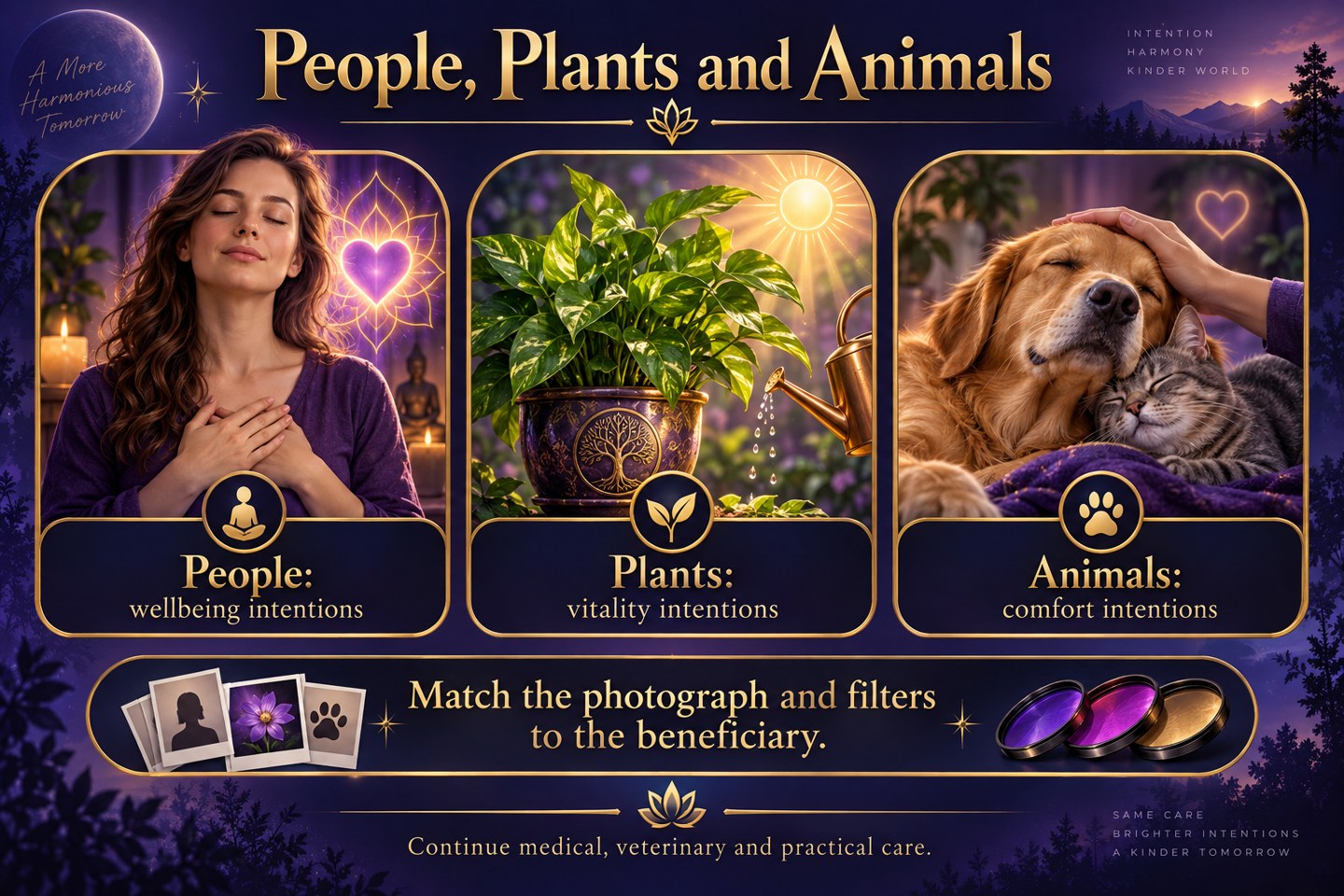
People, plants, and animals can each serve as beneficiaries, yet they call for different intentions and forms of care. Begin with the subject rather than with a favorite template. What are you working with? What quality are you directing? Does the operation’s language fit this particular beneficiary? A human self-confidence decree does not automatically become a suitable plant or animal operation merely because you change the photograph.
For people, the range includes raw Chi sessions, energetic balancing, relaxation intentions, inner peace, meditation, chakra work, aura work, and traditional remote practices such as Reiki, Prana Healing, Bach Flower tendencies, and Sanjeevini work. You can also build personal-development operations for concentration, learning, creativity, confidence, intuition, or a specific freely chosen goal. The beneficiary can be yourself or a person who has agreed to the work.
Personalization is more than changing one name. Review every position that contains a decree. Remove placeholder words, confirm that the beneficiary is correctly named, and check whether any sentence assumes a different circumstance. A template designed for your own concentration should not contain instructions aimed at another person’s thoughts or choices. The photograph, intention, and text should all point toward the same freely chosen purpose.
For plants, a photograph can identify an individual potted plant, a tree, a garden bed, or a clearly defined group. Radionic intentions may concern vitality, harmony, energetic cleansing, and the atmosphere of the growing space. Use a close image for an individual plant and a suitable overview for a garden area. Do not accidentally substitute the whole garden when you intend one struggling plant.
Practical plant care stays specific too. Check light, watering, soil conditions, pests, and species requirements. If you want to learn from a session, record these conditions alongside the template. A plant’s response to improved watering should not be automatically attributed to an energetic operation that happened at the same time. Good observation makes you a more thoughtful caretaker and operator.
For animals, use a recognizable photograph of the particular animal. Comfort, calm surroundings, harmony, and general wellbeing are appropriate intentions to consider with the animal’s caretaker. Energetic cleansing and traditional remote-practice configurations can also be directed toward that animal within the radionic framework. Keep the language suitable to its welfare instead of imposing a human ambition or trying to force behavior.
Human and animal wellbeing warrants one clear boundary: Fire Toolz does not provide a medical or veterinary diagnosis, and these operations do not replace treatment, medication, emergency assistance, or professional care. If the subject is unwell, address that need directly. Radionic practice can accompany an attentive routine of care without becoming a reason to postpone it. A calm, well-defined operation and a responsible practical response are entirely compatible.
7. Places, objects, crystals, talismans, and the atmosphere of a space
A place can be the beneficiary just as a person can. A room, home, workspace, business premises, garden, or other authorized space can be represented through a photograph. The operation then addresses the place as its focus. This opens a different category of work: atmosphere, energetic cleansing, harmony, Feng Shui tendencies, grounding, and other qualities chosen for that location.
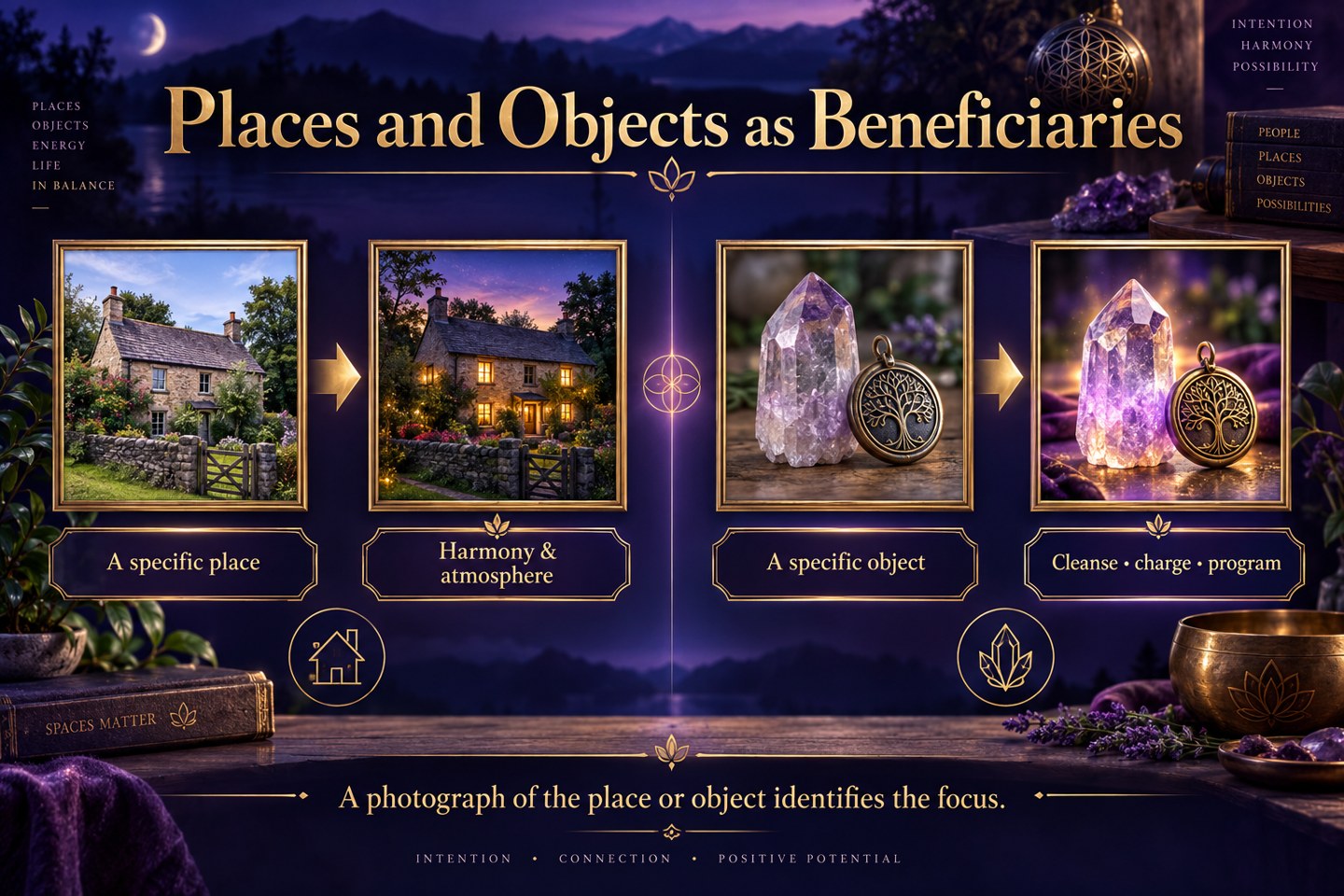
Use the actual place you mean. A photograph of the front of a house can represent the property, while a photograph of one room can specify a smaller focus. A clear drawing or floor plan can help when the layout matters. Give the operation a meaningful label and state whether you are addressing the whole premises or a particular area. Precision matters when several spaces look similar.
Raw Chi transfer to a place is a basic source-to-beneficiary configuration. Adding filters changes the purpose. Harmony, relaxation, or a chosen Feng Shui tendency gives the work a specific direction. A workspace operation may concern clarity and creativity; a bedroom operation may concern a restful atmosphere. Choose qualities appropriate to the space and the people who willingly participate in its use.
Objects provide another broad field. You can identify a crystal, stone, piece of jewelry, amulet, talisman, tool, or other particular object through its photograph. Three intentions often recur: cleanse, charge, and program. Cleansing addresses the energetic condition within the practice. Charging directs the source quality toward the object. Programming introduces a chosen purpose through filters and decrees.
These functions can be kept separate or arranged in a deliberate sequence. For example, a crystal operation can begin with a cleansing template, continue with charging, and finish with a specific meditation intention. Artillery mode can organize the sequence once each template is personalized. A single combined arrangement is also possible when its components belong together and their roles remain clear.
A talisman operation requires an understood purpose. Choose a symbol whose meaning fits the work, identify the actual object, and formulate its intended role. You might dedicate an object to your meditation practice, clarity, confidence, or a particular protective tradition. The operative relationship is source, tendency, and object; an attractive symbol alone does not specify every part of that relationship.
The same discipline applies to protection and space work. A grounding position or protective filter expresses a radionic purpose; it does not inspect a building, prevent a fire, repair wiring, or replace a lock. Maintain the place and object with attention to their physical needs. Avoid cleaning methods that damage delicate minerals or finishes. The craft becomes more coherent when you care for the beneficiary materially while giving its energetic configuration an equally clear purpose.
8. A comprehensive map of Fire Toolz operation types
Fire Toolz offers a broad configuration system rather than one fixed kind of session. The following map brings its principal operation families together. These are purposes you can configure and practice, not guaranteed outcomes. Availability of a particular ready-made template depends on the collection and version you use; custom configurations let you adapt an operation without assuming every named purpose comes preloaded.
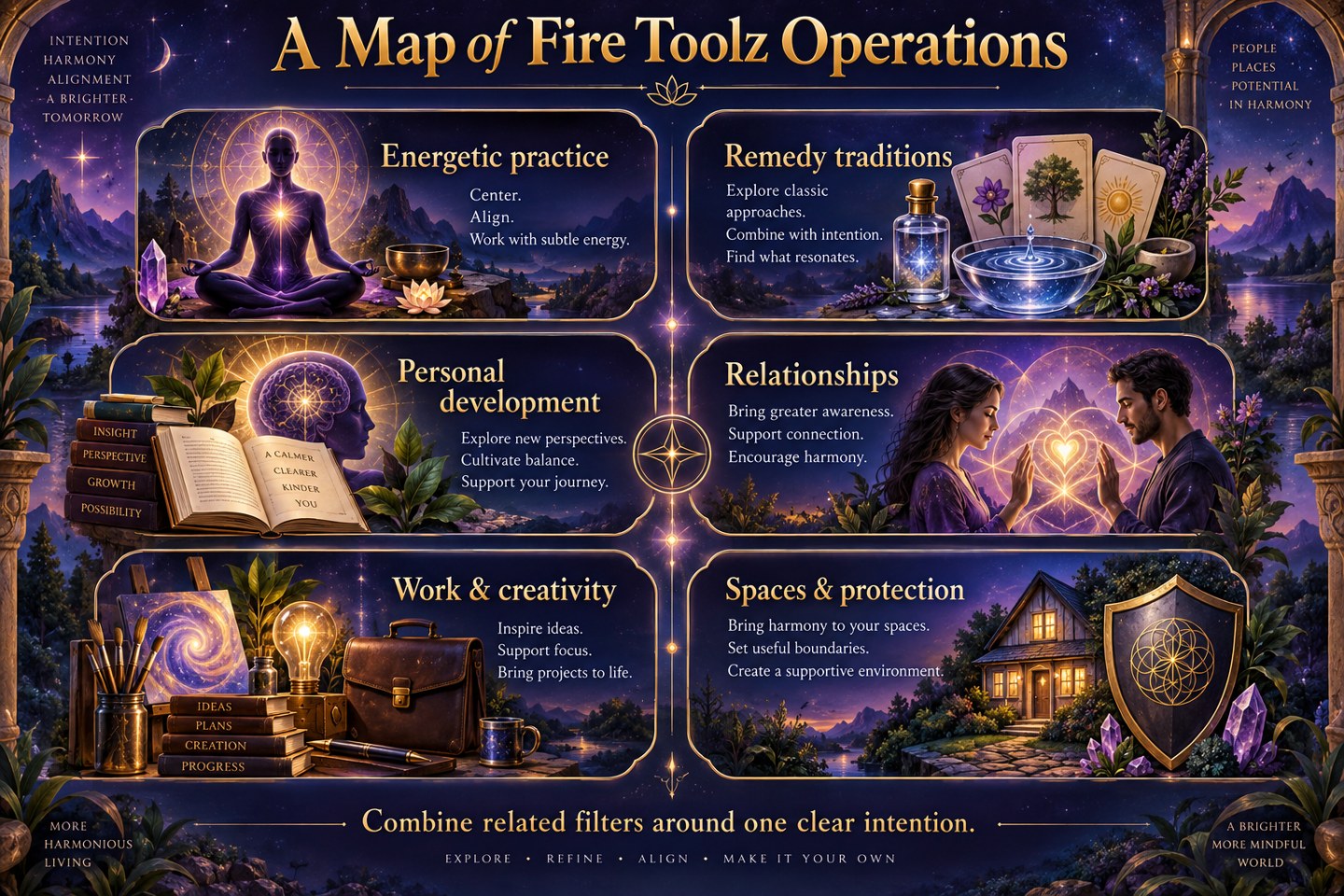
- Basic energy transfer: direct raw Chi/Orgone toward an identified beneficiary; create filtered transfer with one or several coherent tendencies; personalize a session for a person, plant, animal, place, liquid, or object.
- Material imprinting: work with water, other safe liquids, prepared food, vitamins, supplements, sugar globules, pellets, and non-edible objects; distinguish general charging from the imprinting of a particular remedy tendency.
- Radionic remedy traditions: configure Malcolm Rae cards, Sai Sanjeevini patterns, Bach Flower tendencies, homeopathic-style creation or copying, and remote remedy transfer; combine related patterns around a defined purpose.
- Remote energetic practices: arrange Reiki, Prana Healing, general vitality, color-based work, and sound-supported sessions; use specific beneficiary photographs rather than treating every session as an anonymous broadcast.
- Energetic cleansing and balancing: address people, plants, animals, places, and objects; build aura and chakra configurations; use grounding and coherent cleansing sequences when the selected method calls for them.
- Crystals and dedicated objects: cleanse stones and crystals, charge particular objects, program crystals, activate sigils, and create or dedicate talismans and amulets to an understood purpose.
- Space and environment work: arrange Feng Shui tendencies, home and family harmony, workspace atmosphere, garden work, and energetic cleansing of a clearly identified location.
- Meditation and spiritual development: configure intuition, third-eye work, chakra activation, Kundalini-oriented practice, spiritual strength, and intentions that support a defined contemplative routine.
- Emotional and personal development: work with calm emotions, inner peace, optimism, self-confidence, concentration, relaxation, rest, and personally chosen subconscious-reprogramming intentions.
- Study and skill development: arrange tendencies for comprehension, learning, concentration, programming skills, musical composition, poetry, artistic work, and creative projects; connect the session with actual study and practice.
- Relationships and social life: support your own readiness for a compatible partner, strengthen a mutually chosen relationship, cultivate friendships, family harmony, healthy communication, and personal charisma.
- Work, money, and business: configure job-search intentions, client attraction, business stability, marketing, sales flow, negotiations, contracts, financial organization, and the opening of paths around a realistic project.
- Property and item sales: identify a particular house, vehicle, product, or object; build an operation around its sale and the seller’s preparation, visibility, clear communication, and appropriate practical action.
- Astrological and numerological combinations: combine planetary correspondences, intentions associated with retrograde periods, custom astrological arrangements, numerological balance, and related filters without waiting for every correspondence to occur naturally together.
- Esoteric protection and boundaries: configure grounding, aura-focused work, protective symbols, and operations within traditions that address unwanted influences; direct the work toward wellbeing and boundaries rather than diagnosing every difficulty as an attack.
- Physical vitality and routines: configure intentions associated with exercise, stamina, rest, and personal energy; use these as radionic purposes alongside appropriate training and care, without promising physical performance or body changes.
- Specialized luck and environmental intentions: collections also include purposes associated with good fortune, lotteries or games of chance, rain, wind, lightning, and other difficult circumstances. These are esoteric intentions, without assured winnings, control of weather, or protection from natural disasters; maintain ordinary financial judgment and follow official safety guidance.
- Travel, legal preparation, and challenging situations: build intentions for clarity, calm, negotiation, support, preparation, and safe-travel practice; preserve the distinction between a configured intention and a promised legal decision or physical protection.
Across these families, you can use image filters, written decrees, radionic values, per-position audio, template-wide audio, the virtual touchplate, saved notes, and scheduling. Multiple copies of the program can organize different operations when the computer has adequate resources. These capabilities make the work adaptable, while a coherent purpose keeps that adaptability manageable.
Some historical templates use assertive language about winning, attraction, defense, or influence. Treat a template as something to review and personalize, not an instruction to surrender your judgment. In relationship work, preserve the other person’s freedom. In business, do the practical preparation. In protection work, avoid fear-driven assumptions. A comprehensive toolkit becomes valuable through deliberate selection, rather than through attempting every category at once.
9. Building a complete operation in Fire Toolz
Start with one sentence that describes your purpose. “I am directing raw Chi toward this bottle of water” defines a simple operation. “I am configuring concentration and calm attention for my study session” defines a filtered one. “I am programming this crystal for my meditation practice” defines an object operation. Each sentence identifies both the focus and the type of work before you add complexity.
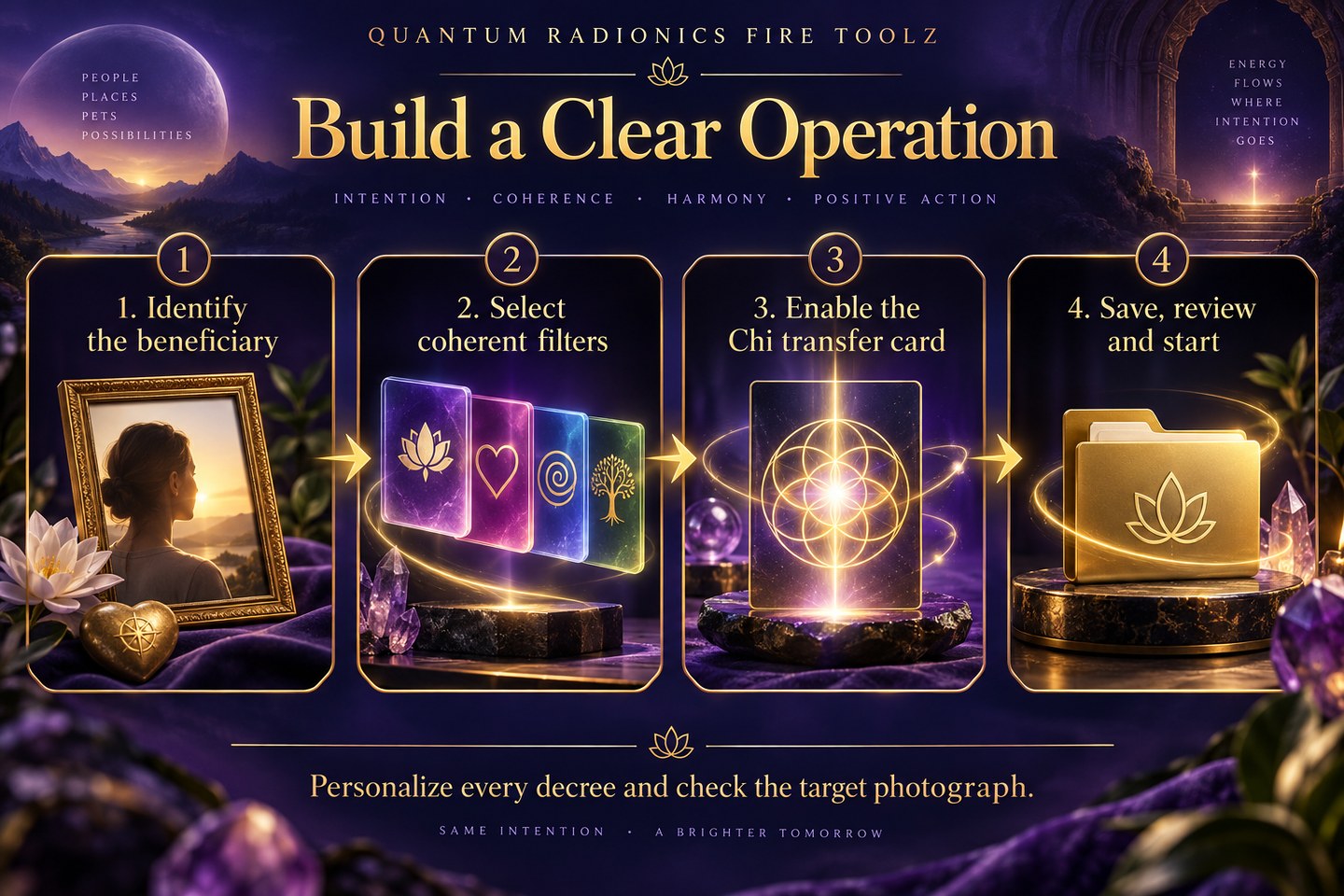
Choose a suitable blank template or personalize an existing one. The number of positions should accommodate the necessary elements, including the beneficiary and any grounding position used by the method. Do not count every visible box as a filter. A beneficiary position serves a different role, and a grounding position occupies space too. Use the capacity shown by your installed version and chosen template.
Load the target photograph into the beneficiary position. Add the correct name or object description where the configuration requires it. Review every decree that contains a placeholder such as BENEFICIARY. Leaving one old name inside a multi-position template creates a mixed configuration even if the main photograph is correct. Personalize the whole operation rather than only its most visible field.
For filtered work, add the resources that support the purpose. You might select concentration, comprehension, and calm attention for study. For object work, choose the intended charging or programming tendency. For raw Chi transfer, preserve the simple source-to-beneficiary purpose instead of adding unrelated filters. Every included position should have a role you can explain.
Configure the source through Chi Transfer. Add a transfer-card entry, load the appropriate card image, and make sure the entry is enabled. Confirm its preview before returning to the operation. An image associated with an inactive entry is not the same as an enabled source. When using several cards, respect the available positions and review each entry individually.
Use the virtual touchplate, radionic values, and audio when they belong to your method. A recorded affirmation can reinforce the language of a decree. Background sound can accompany the overall template. Per-position sound can have a more specific role. Keep the volume comfortable and avoid interpreting a tone label as a medical prescription. These are configurable practice elements, not prerequisites for every operation.
Save the configuration with a descriptive name. Include useful notes about its purpose, resources, beneficiary, and intended sequence. Then use Start for a short review run: confirm that the intended images appear, the source configuration is present, and the operation follows the planned arrangement. Stop it, correct anything inconsistent, and save the reviewed version.
Before you reuse a template, check it again. A new photograph, a different bottle, a changed goal, or an outdated audio path can require an adjustment. Repeatability comes from preserving and reviewing the configuration. I recommend keeping a simple session record so that you can distinguish the operation you intended from the operation you actually ran.
10. Timing, sequences, and a sustainable practice
Fire Toolz provides three distinct timing approaches. The automatic clock schedules a single operation with a date, start time, and stop time. Daily scheduling organizes recurring or dated templates. Artillery mode runs templates in a defined sequence, with an individual duration for each. Choose the mode that fits the structure of the work rather than using automation simply because it is available.
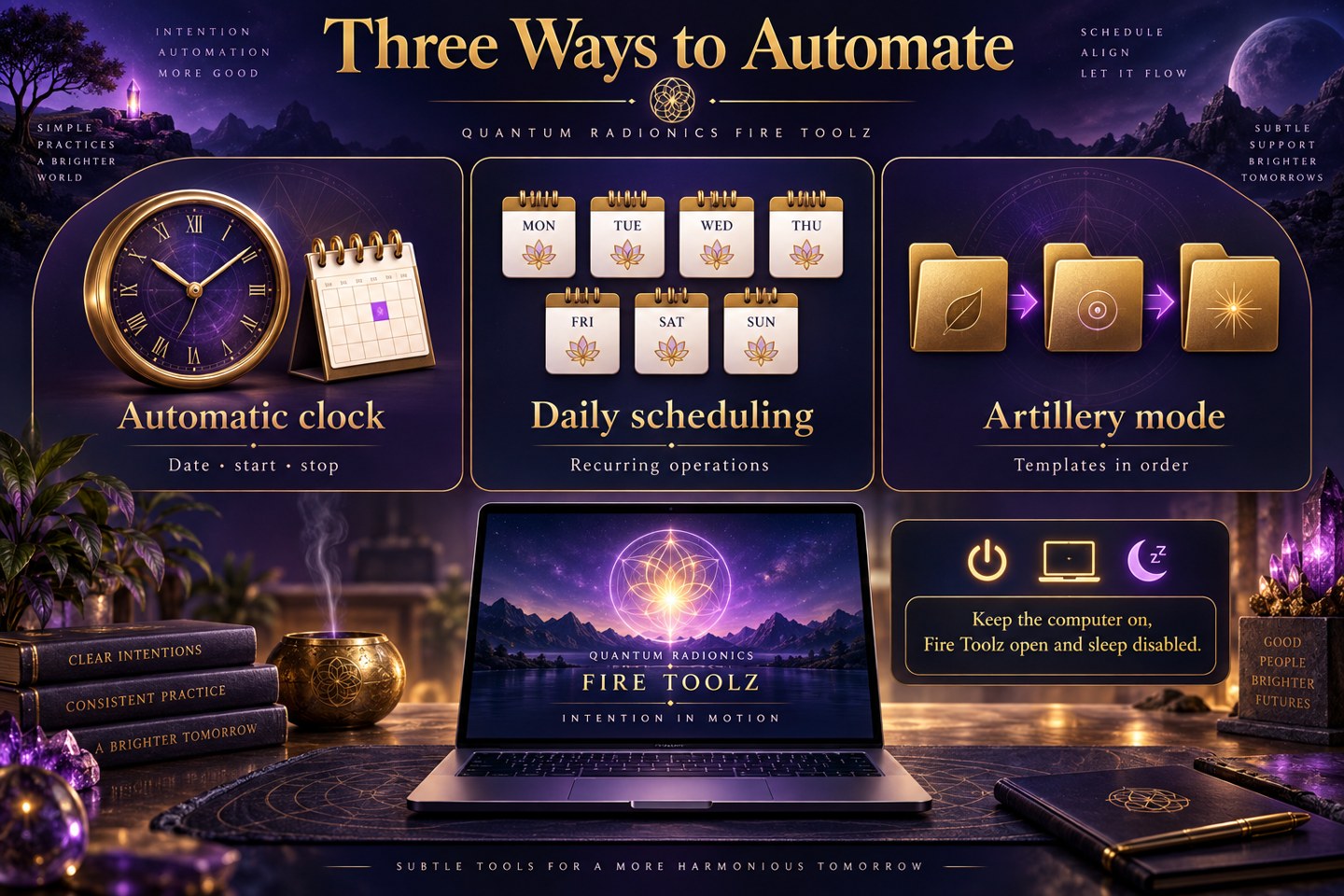
The automatic clock suits an operation you want to begin at a particular time. You can schedule a personalized template for a meditation period, a creative work session, or a date selected within your astrological practice. Check the computer’s date and time, the chosen template, and both boundaries of the session. A correct intention cannot compensate for a start date entered incorrectly.
Daily scheduling organizes up to seven personalized operations. You can organize distinct dated sessions or recurring times. For example, you might keep concentration work associated with study and relaxation work associated with the end of the day. The point is organization: each entry must reference the correct saved template and beneficiary. Do not assume a schedule personalizes the files for you.
Artillery mode runs up to twelve templates in sequence. Load the personalized templates in the intended order and assign each its duration. A cleansing method that uses several stages can be organized this way. So can a deliberate object sequence involving cleansing, charging, and programming. Use the sequence required by the method instead of treating every stage as interchangeable.
Repetition can continue a sequence when that setting is selected. Decide deliberately whether you want it. Check how you will stop the work and confirm the state afterward. Multiple program copies can address separate configurations, but they require adequate computer resources and careful identification of each beneficiary. More open windows do not provide a calibrated measure of greater energetic effectiveness.
The computer must remain on, Fire Toolz must remain available, and sleep must be disabled for the scheduled operation to execute as intended. Minimize the window if you want to do other work, but do not mistake minimizing for closing. A saved template is a reusable configuration; it does not establish that the computer continues running its scheduled process after the program is closed or the machine shuts down.
Duration belongs to the selected practice. Do not universalize the runtime of one cleansing example into a rule for water, animals, crystals, relationships, and business. Nor is a template duration a clinical dose or a guaranteed manifestation deadline. Begin with an understood method, record the configuration and timing, and adapt thoughtfully rather than accumulating unattended sessions.
Keep your observations useful. Record the beneficiary, intention, filters, card configuration, duration, and relevant practical actions. Separate what you observed from what you inferred caused it. If you compare imprinted materials, keep handling conditions alike and use concealed sample labels where practical. If you work on creativity, also record the time you spent creating. That discipline strengthens learning without asking every coincidence to carry more meaning than it can support.
Radionics becomes a richer craft when each operation has a clear destination and a coherent purpose. Fire Toolz brings the photograph, source, filters, language, and timing into one working structure. Start with a simple operation you understand, then expand as each new component earns its place. Explore Quantum Radionics Fire Toolz to develop that practice with reusable configurations and deliberate attention.