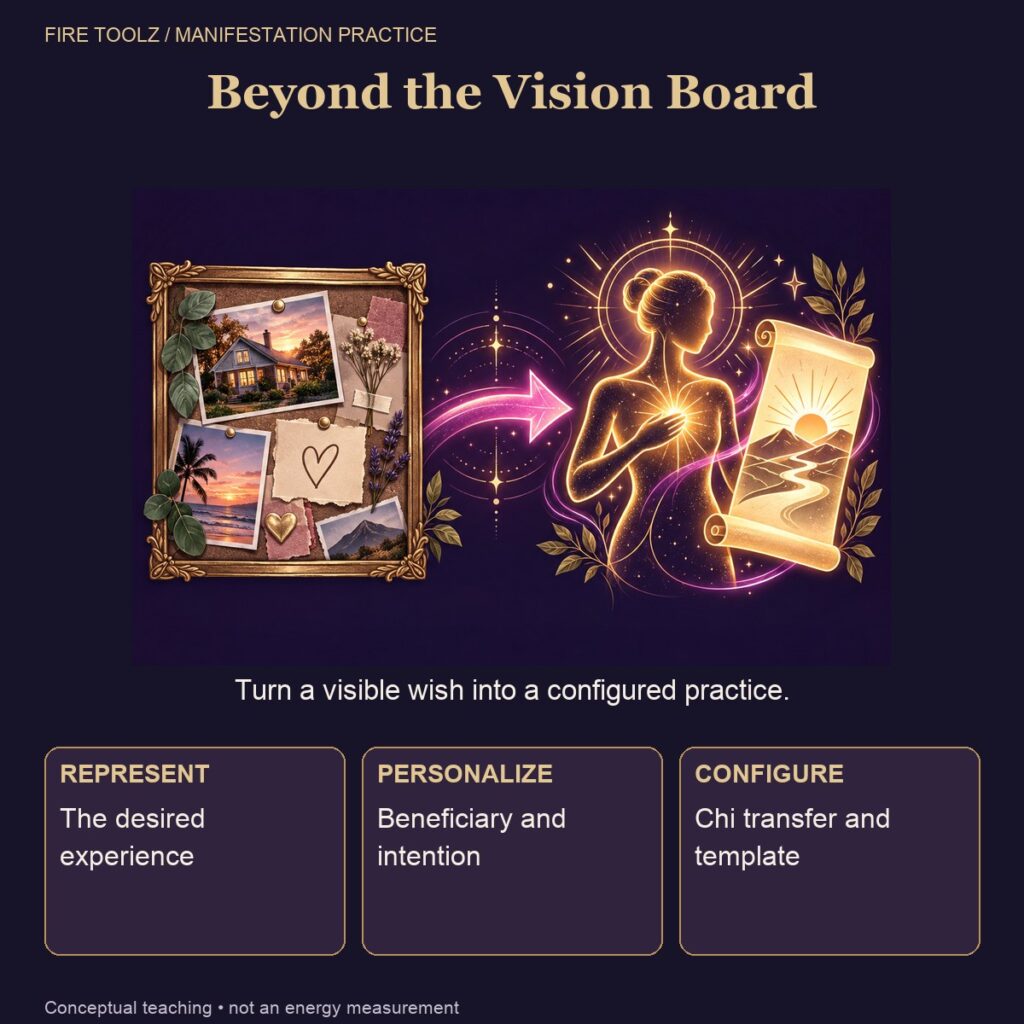
A vision board shows you what you want. A complete radionic practice asks a deeper question: what gives that intention direction, continuity, and energetic support?
You choose the photographs carefully. A beautiful home. Meaningful work. A journey you have imagined for years. You arrange them on a board, add a few affirmations, and place the collage somewhere you will see it every day.
Then ordinary life returns. Your attention moves elsewhere. The board remains beautiful, but the relationship between its pictures and your daily reality becomes less clear. You are looking at the destination without necessarily developing the operation that supports the journey.
This is where I recommend making an important distinction: representing a desire is not the same as sustaining a manifestation practice. A photograph can give an intention a recognizable form. It does not, by itself, supply every element that radionics considers necessary for projecting that intention.
The teaching explored here is metaphysical: intention takes form on subtler planes before finding material expression, and life force supports the connection between the desired pattern and its beneficiary. That framework is different from a scientifically established law requiring every physical event to begin in an astral dimension.
Quantum Radionics Fire Toolz brings this practice into a digital workspace. Photographs, written decrees, radionic filters, the Chi/Orgone transfer card, saved templates, and timed operations work together in a structured configuration. Think of it as a vision board on steroids: not merely more pictures, but a more complete way to organize and maintain your intention.
Let us look at what the ordinary board leaves unfinished, how the mental and astral stages fit together, and how to build a practice that connects inner formation with practical movement in your everyday life.
1. Why a Beautiful Vision Board Can Remain an Unfinished Operation

A traditional vision board is strongest at one task: giving your desire a visible representation. Instead of holding an abstract wish in your mind, you select images that stand for a particular experience. The board makes the destination recognizable and gives you a place to return your attention.
The limitation appears when you expect that representation to perform every other function automatically. A picture of a house does not distinguish between admiring beautiful architecture, wanting social recognition, needing a secure home, or preparing to relocate. Those are different intentions, even when the same photograph represents them.
Radionic practice separates the operation into three essential roles. The beneficiary identifies who or what the work concerns. The trend identifies the desired quality or outcome. Life force supplies the energetic support through which the operation is understood to connect those two elements.
Most ordinary boards emphasize the trend. They show the desired travel, relationship, business, or lifestyle. The beneficiary may remain implicit, and the energetic contribution depends largely on the person's changing attention, emotional involvement, and practice. When you stop engaging with the board, that engagement is no longer being renewed deliberately.
This is the inefficiency I want you to recognize. You can spend considerable time perfecting an arrangement while leaving the actual structure of your practice undefined. More attractive pictures cannot correct an unclear intention. More affirmations cannot resolve incompatible goals. More emotional intensity cannot replace a deliberate method.
That does not mean every vision board fails, or that an unsuccessful goal proves you lacked Chi. It means a board can remain incomplete when evaluated as a radionic operation. Its usefulness as a reminder and its completeness as an energetic practice are separate questions.
Start by examining your own board. Can you identify the beneficiary explicitly? Can you state the central intention without pointing vaguely at the entire collage? Can you explain how you will maintain the practice after the excitement of creating it has passed?
If those answers are unclear, the next step is not another decorative image. It is a clearer structure. Fire Toolz is valuable here because it gives beneficiary, trend, transfer configuration, and execution their own practical roles instead of leaving everything inside one attractive but undifferentiated collage.
2. Formation Before Appearance: Understanding the Mental, Astral, and Material Sequence

Manifestation practice begins before the physical result appears. You first encounter a possibility inwardly: an idea, an intention, an image of a different condition. In the esoteric model, this is not treated as an irrelevant prelude. It is the formative beginning of the operation.
The sequence is more precise than simply saying, “Think about something, and it becomes real.” Will establishes direction. The mental plane gives that direction a pattern. The astral plane gives it a body of desire and feeling. Etheric and dense material expression complete the movement toward tangible experience.
The mental pattern answers, “What am I forming?” The astral stage answers, “What is the felt quality of this formation?” Material expression asks, “Through what circumstances, decisions, relationships, and actions can this become part of my lived world?”
For example, imagine creating a more satisfying working life. The mental pattern might be clear, useful work with appropriate compensation and a sustainable schedule. Its astral quality might include purpose, confidence, relief, and genuine willingness to participate. Its material channels include skills, applications, conversations, contracts, and the actual performance of that work.
Notice how this differs from collecting photographs of offices and repeating, “I have my dream job.” You are giving the intention an organized inner form rather than merely surrounding yourself with signs of an imagined achievement.
The astral world is sometimes called “4D” in manifestation language. Here, that term means a subtler realm of formation and desire. It is not the same usage as the time dimension in relativistic spacetime, and it should not be confused with a measured additional spatial dimension.
Within this spiritual model, you cultivate the subtler pattern before seeking its denser expression. That is the practical meaning of forming the desire first in the astral: create a coherent inner condition that your operation can address and sustain.
Do not use the sequence to neglect ordinary reality. A building needs an architectural plan, but the plan does not remove the need for materials and construction. Likewise, your formative practice belongs alongside the tangible processes through which your goal can become possible. Inner formation and outer participation should reinforce each other.
3. Life Force: The Missing Role That More Pictures Cannot Supply

Life force is central to the radionic explanation of manifestation. Chi, Prana, Ki, and Orgone are names used across different traditions and systems for a vital principle associated with life, movement, and energetic participation.
The important operational distinction is between the pattern of a desire and the life force that supports it. A pattern provides organization. Life force provides the energetic contribution understood to carry and strengthen the connection. Confusing those roles is like confusing a message with the means of delivering it.
Consider the ordinary vision board again. Its images may represent your goal accurately. Your name or photograph may identify you clearly. Yet you are still depending on personal attention and emotional engagement to sustain the work. The entire practice can become an exercise in continually rebuilding your own intensity.
That is why I do not recommend treating exhaustion as proof of dedication. Spending hours trying to force a feeling is not automatically a better operation. If your approach requires endless mental effort, you have built a practice that competes with the very life you are trying to improve.
The radionic alternative introduces an explicit life-force source into the structure. In Fire Toolz, the included Chi/Orgone transfer card occupies that role. It is used as the energetic foundation of the operation, while the filters specify the trend and the beneficiary identifies its destination.
This teaching treats the card as an active energetic component, not as another picture of the desired outcome. The claim that it supplies and transfers Chi belongs to the metaphysical system; it is not a demonstrated physical power output or an experimentally established substitute for a conventional energy source.
The practical question is not whether you can cover a board with more images. It is whether your configuration includes all the roles your radionic practice requires, and whether you have organized them coherently.
A strong intention should not require you to remain emotionally elevated every minute. You can approach your work calmly, refine its structure, and let a configured session remain consistent while you attend to other responsibilities. Energy practice becomes more useful when it supports your life rather than becoming another demand for constant performance.
4. Structural Links: Connecting the Person with the Desired Pattern

An intention needs a destination. “Abundance” written on a page identifies a trend, but it does not explicitly identify the person, place, or situation the operation concerns. Radionics uses structural links to make those relationships specific.
A structural link is a representation through which the practitioner addresses the intended focus. A photograph can identify the beneficiary. An image, decree, symbol, or radionic filter can identify the trend. The operation brings the beneficiary link and the trend link together with its life-force component.
Your photograph therefore has a different role from a photograph of the home you want. One identifies you. The other identifies something you intend to experience. Keeping that distinction clear makes the arrangement more intelligible than a collage in which every image is treated as interchangeable inspiration.
In Fire Toolz, load the beneficiary's photograph into the beneficiary area and personalize the name where required. Some English templates use the visible label “Target.” This field identifies the focus of the operation; it is not a reason to treat another person as an object to control.
Choose a photograph that identifies the beneficiary unambiguously. A group photograph may create unnecessary uncertainty when you intend to work for one person.
Next, examine the trend links. If you want a peaceful, workable home, choose representations that convey those qualities. A photograph selected only because the property is expensive may introduce a different emphasis from the one you intended. Your image should express the experience, not merely the prestige attached to it.
A written decree helps resolve ambiguity. “I live in a safe, suitable home that supports my daily life” gives the image a clearer context than “Luxury now.” The wording does not guarantee an outcome; it specifies the pattern you are choosing to cultivate.
The resulting connection is easy to understand: this beneficiary, this desired condition, this configured life-force support. That is the radionic linkage at the heart of the practice. Maintain clean distinctions between each component, and your template becomes an organized expression of intention rather than a collection of attractive but competing suggestions.
5. The Chi Transfer Card: An Energetic Foundation, Not Another Wish

The Chi/Orgone transfer card is what most clearly separates the Fire Toolz operating model from an ordinary vision board. It occupies the source role, while the other elements tell the operation what trend to address and where to direct it.
Its metaphysical design uses sacred geometry and associations with creation and the Great Pyramid of Giza. In this framework, those associations function as structural links to the source of life force. The card is configured to supply the energetic contribution used in the operation.
Do not confuse its role with the role of an abundance filter. An abundance filter specifies a desired quality. The transfer card supplies the life-force foundation attributed to the system. The beneficiary photograph identifies the destination.
The conceptual flow is simple: transfer card → intention filters or decrees → beneficiary. This expresses how the life-force contribution is understood to take on the selected trend and connect it with the person or other focus of the operation.
Fire Toolz provides a “Chi Transfer” control for the transfer configuration. Use the authentic included card and the settings appropriate to your template and software version. Do not replace an operational card with a lookalike graphic merely because the imitation appears more mystical.
Once a session is started, the program's visual movement presents the configured operation dynamically. That movement belongs to the software workflow. It should not be mistaken for a measurement showing how much Chi has reached a beneficiary or how close a physical outcome is to appearing.
The card is also not a shortcut around unclear intention. If your decree contains contradictions, configuring a source does not decide which contradictory desire you truly mean. If your beneficiary is incorrect, adding more energetic emphasis does not correct the identification.
I recommend checking structure before considering intensity. Confirm the beneficiary. Confirm the trend. Confirm the transfer configuration. Read the template's practice instructions. Only then start the session.
This changes the central question from “How hard can I want this?” to “How completely have I configured this operation?” That is a more disciplined foundation for manifestation work. It respects the life-force role without turning every difficulty into a demand for more cards, longer sessions, or greater emotional strain.
6. Quantum Physics and Entanglement: A Powerful Concept with a Precise Meaning

Quantum physics matters to this discussion because it challenges the everyday assumption that reality consists only of independent objects with fully separate properties. Entanglement describes quantum systems whose joint state cannot be reduced to independent states of their parts.
Experiments with entangled photons have established correlations that violate Bell inequalities. These findings are part of genuine quantum information science, not simply a poetic way to say that everything is connected. The 2022 Nobel Prize in Physics recognized pioneering work in this field.
That scientific result has a specific scope. It does not establish that every particle is entangled with every other particle, or that visual similarity between two photographs creates an entangled quantum state. Entanglement is not a general permission to transmit chosen intentions or life-force energy instantaneously.
In radionic manifestation, the quantum and holographic framework offers a broader interpretation of connection: the person, the desired pattern, and the life-force contribution are brought into an organized relationship rather than treated as unrelated pieces. Structural linkage is the practical concept used to configure that relationship.
When I speak about connecting a desire with its beneficiary, this is the mechanism I am addressing. Fire Toolz combines the beneficiary representation, the trend representations, and the Chi transfer configuration into one operation. Its metaphysical language describes that relationship as quantum linkage or entanglement.
Keep the distinction exact: a radionic structural link is not the same thing as a laboratory-prepared shared quantum state. The claim that the Chi card physically creates quantum entanglement between a person and a desire has not been independently demonstrated. The term describes the system's theoretical interpretation, not an established measurement of its operation.
You do not need to borrow the authority of photon experiments to explain why beneficiary identification, coherent filters, and consistent sessions matter within your practice. Nor do you need to erase the metaphysical framework to describe it intelligently.
The quantum perspective can invite you to reconsider simplistic separateness. The radionic method tells you how to organize your own operation. Keeping those contributions distinct lets you explore the connection seriously, without replacing careful practice with impressive terminology. Use quantum language to clarify an idea, never to conceal an unexplained leap.
7. A Vision Board on Steroids: What Fire Toolz Actually Adds

The phrase “vision board on steroids” becomes meaningful when you examine the software's functions. Fire Toolz does more than display desirable images. It gives you a configurable environment in which you can identify the beneficiary, specify trends, configure Chi transfer, preserve the arrangement, and run it deliberately.
Load your own suitable images as intention representations. Combine them with relevant radionic filters and written decrees. Place the beneficiary at the center of the operation's logic, rather than assuming that a collection of aspirational images automatically identifies the person receiving the work.
The virtual touchplate adds a place for focused mental participation. Use it to establish your intention clearly before execution. Treat it as a deliberate practice component, not as a sensor that objectively proves your desire has been accepted by the astral world.
Save the personalized configuration as a template. This is a major practical improvement over repeatedly reconstructing a collage or trying to recreate an earlier mental state. A saved arrangement preserves your chosen beneficiary, representations, and wording so you can return to the same configuration.
The software also supports audio associated with individual filters and background audio for an operation. These options let you integrate a compatible affirmation or sound into the practice. They are optional refinements, not requirements to make a beginner's template excessively complicated.
Timed functions allow operations to run at selected dates and times. Artillery mode allows a series of saved templates to run in sequence for specified durations. These are different tools for organizing execution; a sequence should have a clear purpose rather than simply containing every template available.
You do not need to keep rebuilding the visual representation or repeatedly reminding yourself which elements belonged to the operation. You can preserve it, schedule it, and review it as a deliberate piece of work.
This is not a promise that software control creates control over external events.
A board reminds you of a possible future. Fire Toolz lets you construct and maintain a radionic operation around that future, with each component serving a defined purpose.
8. Build One Coherent Operation Instead of a Collage of Competing Desires

Start with one meaningful objective. I recommend a goal you can describe clearly and support through real decisions. “Improve everything in my life” is too broad for a useful first configuration. “Develop a satisfying working life that fits my skills and responsibilities” gives you something more specific to form.
Write the central intention before choosing images. This prevents an attractive photograph from deciding the goal for you. Ask what the desired experience actually includes: useful work, suitable conditions, reasonable compensation, a workable schedule, or a particular kind of contribution.
Identify yourself as the beneficiary with your name and photograph. Review every decree in a loaded template and replace beneficiary placeholders where necessary. Changing the central photograph alone does not personalize text that still refers to an unnamed or different beneficiary.
Select only filters and images that contribute to the same outcome. For a working-life intention, a coherent arrangement might emphasize confidence, relevant opportunities, concentration, and the development of useful abilities. This is an illustrative configuration, not a required sequence of specific included cards.
Remove unrelated ambitions. A travel image, a relationship image, and a professional image do not become one coherent operation simply because all three are desirable. Give unrelated goals their own configurations so each can retain an intelligible direction.
Configure the included transfer card through “Chi Transfer,” following the appropriate setup for your version. Use the touchplate for a calm period of focused intention if it belongs to your method. Review the beneficiary, wording, images, and transfer settings together before execution.
Save the template with a name you will understand later. “Suitable Work — My Name” is more useful than “Power Session Final 7.” Keep brief notes about the intention, the configuration, and the practical actions you will take alongside it.
Start the operation using “Start” and follow the chosen template's own runtime guidance. Do not turn a duration attached to one protocol into a universal rule for every manifestation. Longer is not automatically more appropriate.
Finally, move into the day with a corresponding action: revise your portfolio, contact an employer, improve a relevant skill, or clarify your availability. You have formed an intention and configured a practice. Now give that intention an opportunity to meet the material world through participation.
9. Continuity Without Obsession: Let the Configuration Work While You Live

A manifestation practice becomes inefficient when maintaining it consumes the life it was meant to support. If you spend the day watching your board, checking for signs, and repeatedly changing the intention, you are no longer cultivating continuity. You are rehearsing uncertainty.
The scheduling functions in Fire Toolz help separate execution from constant supervision. A saved template can be assigned an appropriate starting time and duration. A defined sequence can be prepared in advance. Your role shifts from repeatedly rebuilding the session to configuring and reviewing it deliberately.
The computer must remain on and capable of running the program. Sleep mode can prevent a scheduled operation from executing as intended. A timer is not a cloud service, and minimizing the window is not the same as closing the application or shutting down the machine.
Check those ordinary technical details. Confirm that the correct template is selected, its personalization is complete, and the intended schedule is set. Reliable software execution begins with a reliable setup, not with assumptions about what the program does while the computer is asleep.
Once the operation is running appropriately, return to your responsibilities. Complete the application. Have the conversation. Organize the budget. Practice the ability your goal requires. The value of automation is that it can reduce repeated hands-on attention, leaving you available for those activities.
Do not interpret every passing doubt as an energetic disaster. Human beings experience changing moods, disappointment, distraction, and fatigue. A difficult afternoon does not prove you have destroyed a thought-form or caused an external setback.
Likewise, avoid revising the entire template whenever a result does not appear immediately. Give yourself a deliberate review point. At that time, examine clarity, compatibility, execution, practical readiness, and observable developments. Make changes for identifiable reasons rather than to relieve momentary anxiety.
Consistency is not rigidity. You can refine an intention when circumstances genuinely change. You can stop an operation that no longer matches your priorities.
The aim is calm continuity: a defined configuration, appropriate execution, meaningful action, and measured review. Fire Toolz supports the configuration and execution portions of that rhythm. Your judgment remains essential to the rest.
10. From Astral Formation to Everyday Participation: Make the Practice Complete

The strongest conclusion is not “Throw away your vision board.” It is “Stop asking the board to do work you have never actually configured.” Keep the images that express your intention accurately. Give them a beneficiary, a coherent trend, an explicit life-force role, and a practice you can maintain.
In the metaphysical sequence, you form the pattern mentally, cultivate its astral body of desire, and support its movement toward material expression. Fire Toolz offers a digital way to organize that work. It does not remove the need to recognize how the desired condition can enter your actual circumstances.
For a home, that may include affordability, availability, paperwork, and a realistic search. For satisfying work, it may include competence, communication, and appropriate opportunities. For companionship, it includes mutual willingness and respect. No configuration should be used as a justification for overriding another person's autonomy.
Choose goals that invite constructive participation. A decree supporting your confidence and readiness is different from a decree intended to force a specific person to comply. The quality of your intention includes the way you relate to the people involved.
Keep a simple practice record. Note what you intended, what configuration you used, whether the session executed correctly, what actions you took, and what actually happened. Separate an observable event from your interpretation of its energetic meaning. This gives reflection a firmer foundation than a collection of remembered coincidences.
When progress is limited, review the whole situation. An unclear pattern, incompatible priorities, insufficient skills, unavailable resources, and other people's choices all deserve consideration. Do not automatically explain disappointment as a hidden attack, a defective vibration, or personal failure.
Your intention deserves better than either passive wishing or frantic effort. That is where the “vision board on steroids” idea earns its substance.
You are no longer merely displaying a future. You are giving the future a defined place in your practice: formed in thought, developed through desire, organized with radionic components, and met through tangible participation.
Begin with one intention you genuinely want to live. For English-language guidance on radionics, manifestation, and Fire Toolz, visit the Orgone Radionics YouTube channel and explore how to bring clarity, structure, and consistency to your practice.